Now, no one phrases it this way, but Jeptha Wade was the man who killed the Pony Express (24 October 1861). Beginning in 1847, he made his first million by contracting the building of telegraph lines. In 1856 he moved to Cleveland. Wade, and Hiram Sibley (who had been a partner of Samuel Morse) consolidated telegraph companies. Wade eventually became president of the combined company, Western Union Telegraph Company. He sold his interest to Jay Gould in 1867. He received more money, from steel, banking and railroads. Wade donated much land which became home to the institutions of University Circle, Cleveland.Technology changes commerce. Western Union is still in business. It 'wires' money. It does not transmit telegrams. Many people who have received telegrams, had the note announcing a death. Wade gave land for Lake View Cemetery, and was its organiser and president. The telegram is dead. Now, a similar contrivance has replaced it in part. 'Twitter' is a mobile social messaging service [my that is a clunky phrase]. Now, while it may pass along news, and in current popular demonstrations under repressive governments — it did; much of it is nonsense, babble, and advertising. Apparently this can be done on the internet, as well as the mobile, électronique telephone. 'Twittering' (referencing bird chatter), then, is telegraphing for idjits, and an individual 'tweet' is the idiot's telegram.Now, a few days ago, a news story was carried that the pope has made his first tweet. The church trying to be current, okay. This made all sorts of semi-news broadcasts. It seems the local diocese had done so a time before. This only came to my ken when a friend told me to look at Michael McIntyre's tid-bit column, in the very plejndjilar. In Saturday's copy of the Cleveland daily, he writes of a tweet of the day before:
McIntyre caught a diocesan flak issuing that statement ripe in hypocrisy and irony:Unless God's house, to you, happens to be one of the dozens of parishes in the diocese that have been closed in the last two years. Parishoners of St. Peter, for example, certainly considered themselves locked out; They broke from the diocese to start their own congregation after their church was closed. St. Prokop is padlocked. St. Casimir is fenced off. The message may be sound. The diocese may need some work on its analogies, though.
That may very well be the only instance of a punch laid on lennonism by the local press. The diocese has been very controlling in the shape of its news coverage. Reporters have the tendency to transcribe without probing, allowing less than credible statements stand. Investigative reporting has been squashed. Reporters have been told not to travel that path.Robert Tayek, the designated liar, is quoted saying:"There is a wonderful history in this diocese of people supporting the church and, especially, their local parishes."
This was in response to Lennon's signature new project, a capital campaign for $125 million. Well, there he is speaking truthfully; but inconsistently and manipulatively. Yes, people do support their parishes, and your employer liquidates them for dollar notes. Now he wants more.The writer tells us, that Tayek tells him, that the "fundraising campaign was introduced after three years of planning". The writer does not bring up the obvious about the previous point, and he doesn't write (and probably didn't discuss) why it took three years, nor what other target figures were suggested, nor what the other heap of money was doing. Lennon enjoys the largest assessment (bishop's tax) in North America. He has sold many properties, real estate and furnishings. Yet he still needs money. There is much vagueness, that is not questioned, in the specifics of what the new campaign is for. In Berry's recent book, there are examples where bishops give large cash gifts to the Vatican. That may not be the destination of a cash cluster, but heaps have been accumulated; and it is always the first order of business.
On Cleveland's West 22nd street, people came to mark the exact year anniversary (30 June) of the closing of the 58th parish in the five years of the episcopal reign of Richard Lennon. Each parish's name was read out, and an old fire alarm bell was tolled for each. They prayed several prayers, including a prayer for the Divine Mercy. They sang several songs, including Faith of Our Fathers. They told of the news elsewhere too. Mater Dolorosa parish in Holyoke, Massachusetts just started a sit-in vigil in their parish. Yesterday, a church was dedicated in Westerville, Ohio that bought a statue from the still appealing St. Peter, Cleveland. They spoke of the hurt they felt, and the deceptions that occurred because of Lennonism. They had warm anecdotes of their parishes. A story of a man in his 90s pulling the plug on Lennon at St. Casimir's was applauded. They spoke of the mismanagement, and misrule in the American Church. Fr. Sandor Siklodi came back from Chicago to talk to his parish and friends. People spoke on the steps of the Hungarian parish of St. Emeric (Imre).
 A crowd of 250 maintained for approaching three hours. Some left early, some came late, so that some more than that came in total.
 Michael Polensek, the councilman from Collinwood, spoke of the importance to the neighborhood each church is. When a church goes away, the city around it decays.
 Many speakers, from several parishes, and the officers of Endangered Catholics spoke. Some spoke very well, some spoke too long. Each held passion for their closed parish, and the fate of others.
 The crowd was very attentive throughout, and occasionally responded enthusiastically.
 Dr. Kenneth Chalker, Senior Pastor, University Circle United Methodist Church, perhaps stole the show. He spoke of the 59th parish that closed — the spirit and feeling of ecumenism. He spoke of the welcome and fellowship, he felt for the previous ordinary, Anthony Pilla. The new bishop, Richard Lennon, who except for one early appearance, when advised that it was a good political move, had no interest in ecumenism, or anything that approached it.
 Some cameramen came, including one, believed to be, from the diocese. He left early. There was no police presence at all. It was a very peaceful demonstration.
 For all but one closed parish, in the Cleveland Diocese, it has been a year since eviction. Some still are awaiting appeal from Rome. It has always been the last recourse for a Catholic to appeal to the Pope and his governance. This past Sunday marked one year since St. James, Lakewood, and St. Mary, Akron Ohio were dislodged. This Sunday was also Corpus Christi, it has been traditional for over seven hundred years to have an Eucharistic procession. The pastor at St. Bernard’s (the parish that St. Mary's was merged into) officiated at an outdoor Mass and procession at St. Mary’s. St. James had their weekly prayer vigil, and took note of the year that has passed. More than fifty came, and near two hundred at St. Mary's.
 The author of their troubles is Richard Lennon, who did the same for Boston, previously. Boston will have a second round of reconfiguration, and the archdiocese publicly realises how bad things were the first time. Now 17% of The archdiocesan’s Catholics attend Mass. The chancery says it is “absolutely clear that the archdiocese is not going to be closing churches from above”. They learned from Lennon’s mistakes, they will just not call it that.
The Torinese newspaper, La Stampa,* writes that the Congregation for the Clergy and others has a document to be released “dedicated to the reorganization of American dioceses”. The cause of which was the settlement payments of the sex scandals.
The author of their troubles is Richard Lennon, who did the same for Boston, previously. Boston will have a second round of reconfiguration, and the archdiocese publicly realises how bad things were the first time. Now 17% of The archdiocesan’s Catholics attend Mass. The chancery says it is “absolutely clear that the archdiocese is not going to be closing churches from above”. They learned from Lennon’s mistakes, they will just not call it that.
The Torinese newspaper, La Stampa,* writes that the Congregation for the Clergy and others has a document to be released “dedicated to the reorganization of American dioceses”. The cause of which was the settlement payments of the sex scandals.
“A ‘classic’ negative example of the reorganisation linked to the economic problems is that of Cleveland, where the Holy See has decided to send an apostolic visit, or rather, an investigation to look into whether the decisions taken by the Bishop Ordinary Gerard Lennon were adequate. He announced that 29 parishes will close and another 41 will be merged. The restructuring plan which will cut 52 parishes out of 224 is already in effect. Other cities in which word about closure has been heard are Camden, New Jersey, Allentown, Pennsylvania and New York City. The reasons that prompted the decision to close parishes in Cleveland have been the flow of population to outlying areas, the financial difficulties that have seen 42% of parish budgets finish in the red and the shortage of priests. Now this last point is questioned by the Vatican and the apostolic visit will serve to ascertain the facts. The Vatican has asked Lennon to stop his policy of savage cuts. In Boston, amongst many other controversies, he closed 60 parishes. So far the Vatican has not had any luck.”
The United States has nearly 200 dioceses. There is more than 180 countries in the world. There then are a lot of examples to point out. Lennon is the example of what not to do.
On the 18th of June, the Holy Office’s Promoter of Justice, Monsignor Charles Scicluna talked to the press about the abuse crisis. The following question was asked:
Q: And when the bishops are not good shepherds, what can be done?
Scicluna said, in response, “each faithful has the right to express his concern about the diocese directly to the Holy See, through the nuncio.” This principle is not about just this grave, horrible sexual abuse scandal. It is an absolute principle.
The highest echelons of the Church knows things are bad. They are slow to respond. They know people have the right to complain. Things may be addressed, but parishioners need to carefully and repeatedly state their concerns. There is much inertia that has to be overcome. Past problems may not be repaired, but something can be done.
________________________
*La Stampa has the third largest circulation in Italy. It is from Turin (Torino), owned by the Agnelli family, who also own Fiat.
 the angel seems to be rooting for God's own teamHerman N. Matzen *1861 †1938, was a Danish immigrant to Detroit. He then studied sculpture in Paris and Berlin. From 1885 to 1926 he taught at Cleveland School of Art. He won many commissions to sculpt monuments for local governments. He had done statues of Schiller (Detroit) and Wagner. American germans had great enthusiasm for cultural heroes. The war ended those commissions from the germans. He was especially busy in Cleveland in the years before America’s entrance to the Great European War (WWI).He did two religious lawgivers (Moses, Gregory) for the Cuyahoga County Courthouse, and Cain and Abel for the Lake County one, and two allegorical figures (Law, Justice) for Summit County. The bronze seated Mayor Tom Johnson on Public Square, Cleveland is his work. He was the best in his craft in the area. The 1908 bronze relief for the victims of the Collinwood school fire in Lakewood was his work. He did a number of funereal monuments for the wealthy at Lake View. Recently, whether it is the goth fascination, or the ease of digital photography, the most shared photo of his work on the internet is a bronze angel he sculpted for Haserot in 1923.This seated angel leans on an overturned torch as on a cane. There is many stone angels in this graveyard, most stand on top of massive pediments. Matzen’s angel is on a slight red granite one, on which you can easily step upon. It is a statue one can go face to face with. The massive wings are fully opened, and further suggests, that, the angel is enthroned. The torch’s flame is out, and the angel is contemplating judgment, or somberly reflecting upon the deceased.
I like the work. Many are fascinated with it. At what time did its popularity begin?

Robin on sign
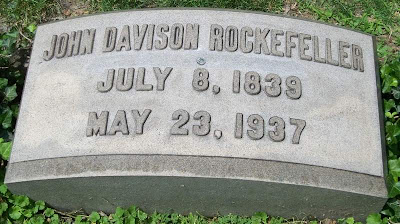 notice the dime above the center 8; not pictured -- 70' white granite obelisk from Barre, VermontLake View Cemetery is one of the largest graveyards in Ohio. It sits in Cleveland, East Cleveland and Cleveland Heights. It was created for the millionaires (the Republicans and the robber barons, the political and economic victors of the failed War of Secession) on Millionaires’ Row (Euclid Avenue), near Rockefeller’s summer home. The main gate is on Euclid Avenue. In 1869 this was out in the country, beyond the city limits.Rockefeller was once the world’s richest man, richer than Gates or Slim are to-day. For Orthodox Easter Monday 1914, the Colorado National Guard murdered women and children of strikers, and striking coal miners, in Ludlow. The owner of the largest mine was old John D, and his son, John D. Junior. The massacre was not well received by the public. Rockefeller hired an early public relations man, ‘Poison’ Ivy Ledbetter Lee (he would later work for nazi businessmen) to create better press. Lee said the burning of the tent village began with an overturned stove. It was the state troops setting the tents afire. Other than raw lies, he had some clever ideas. He had Rockefeller pose for pictures as a kindly old man. Rockefeller became famous for giving children dimes.Now, the cemetery, and others, like to say, that, people leave dimes and pennies in a superstitious offering. Giving a dime back to John, may have money coming to you. Could not, one coin be there to mock him? What good did the first collecting of the first billion do for John at his death?Well, Lake View is kept as a park. Italian stone cutters were brought in to carve monuments, and they and gardeners were kept busy. It is a favorite for amateur photographers, and the shutterbugs find the same things to photograph, because the same things appeal to people’s eyes. Jeptha Wade of Western Union Telegraph was the founder. His grandson contracted Louis Comfort Tiffany to furnish a chapel on site. There is a monument, and museum for President Garfield.
 Different tours are conducted through the grounds. Some are of the buried, some are of the 19th century statues, some are of the flora. Some consider it an open air art museum, some an arboretum.Over an hundred thousand are buried there. It was meant for Cleveland’s better citizens. It was non-sectarian, which then meant all protestants. They eased that. On Ash Wednesday 1908, the Collinwood (or Lake View)* school fire, had 172 children and three adults perish. Many were immigrants. Bishop Ignatius Horstmann had a heart attack during the burials, and died two months later. He is not buried there. In his episcopate 30 parishes were created, 22 of them nationality parishes. He saw people go over to the Polish National Catholic Church, and to an independent parish. He had five thousand slovenes from one parish (N. Y. Times misidentified them as poles) protest outside his home. Many catholics then protested bishop’s actions when they saw it fit. What would they have done to a bishop whom closed parishes, and sold the properties? Well, that was not done then. Horstmann had troubles with the americanists also. He fought Rome for four years to have Fr. Joseph Koudelka made an auxiliary bishop, and vicar general of the Slavs. When this was allowed in January, none of the irish priests attended the consecration. Priests were more unruly then. Now, Cleveland has a tyrant for a bishop, and little opposition to his tyrannies from all but a few parishioners and less priests.The catholic convert, and ball player, Raymond Chapman is buried there. He was struck in the head by a pitch in 1920. There was an organised protest in allowing a catholic funeral for the ball player. There is no opposition, now, for a catholic to be buried in Lake View. The catholic cemeteries of the diocese are a big till, with several dippers, and a good hiding place. His wife and posthumous daughter are buried in Cleveland’s Calvary, as is his double play partner William Wambsganss. To-day, baseball equipment is left by Chappy’s stone. Years before [1909], a minor league ball player, who also died from a pitched ball was buried in Lake View. For an hundred years he had no stone. Charles Pinkney Jr. last of Collinwood, and the Dayton Veterans. His stone came last year.________________*the name of the school was Lake View, in Collinwood
 foto taken in hallway of Trinity (Anglican) Cathedral, Cleveland.“In our era, the road to holiness necessarily passes through the world of action.” — Dag HammarskjöldJesus taught the Beatitudes. It is a programme of action. Jesus was not crucified for personal piety. He was crucified because of his radical, and revolutionary teachings. The powers that were then, and are now, are threatened by justice, mercy, love and equity.We have divisions in Christ's Church. It is apparent in Catholic Christianity. Some people are only interested in personal piety. If Jesus limited himself to this, there would have been no christianity.Calling for (and, hopefully, practising) personal piety is efficacious. Calling only for personal piety, and not christian practice is hypocritical and, possibly, duplicitous. One can see christian practice, and its fruits; personal piety — not so much. A charlatan, a scoundrel, or worse can elicit this campaign. To allow evil, or just the practice, to continue, and do nothing to remedy it can be a part of this programme. One may have no belief, and feign, or speak of great faith. He may advise this in others, while preventing good to be done, so that evil can be done.What shall it profit, my brethren, if a man say he hath faith, but hath not works? Shall faith be able to save him? And if a brother or sister be naked, and want daily food: And one of you say to them: Go in peace, be ye warmed and filled; yet give them not those things that are necessary for the body, what shall it profit? So faith also, if it have not works, is dead in itself. But some man will say: Thou hast faith, and I have works: shew me thy faith without works; and I will shew thee, by works, my faith. Thou believest that there is one God. Thou dost well: the devils also believe and tremble. But wilt thou know, O vain man, that faith without works is dead? —James ii. 14-20.
Some years ago, i worked with a fellow that was a legend in the local. He was physically strong, he enjoyed fighting, and wrestling. A lot of bosses look at us as beasts. The strong, athletic men are presumed to be work producers and are favored. Well, Jack was near retirement. He was strong still, he also was mean, clever, and quite bright. He was often emotionally vicious. He would ride men till they snapped. He made some cry. He liked revenge. Most of all, Jack liked Jack. Now, Jack would do good for some, and sometimes without their realising or knowledge. He knew the difference between right and wrong, he just chose not to abide by it from time to time. If one tried to prevent him, scold him, shame him in refraining from bad behaviour, he would do what he wanted. He would show remorse, from time to time, and admit mistakes. He knew when to lie, and enjoyed it; but fundamentally he was honest, and he would unnecessarily be brutally frank and crude. Jack maintained he was a christian, some calvinist inspired Baptist. He did talk about ethics, and theology. He disagreed with catholicism, but he did not have venom for it.He would also play up to his bosses. He would also, sometimes, act against his best interest when he enjoyed the action. He was very entertaining, when one was a spectator, and not a target. Jack was quite verbal. I have heard him speak with daggers. His tongue was like a blade thrust between the long and short rib. The authority figure would wince and fume, and silently vow for revenge, and wait for the moment.Jack also liked money. In the morning, on company time, when he could, he would look at the stock listings and underline his holdings: past, present and future. Once there was down time at work, and he talked of retirement investments; and all these management tourists came by. They were pissed; work was at a stand still (conditions, reasons and circumstances explained why; they don’t care why), and labor was talking finance. On another occasion, before my acquaintance, I forget the tale’s intro. Jack and someone had an argument. Jack said, “It’s not about the money”. He thought about it. The next day he came in, and he said, “It is about the money”. When they say it’s not about the money, its about the money.“It’s not about the money, Steve!” yelled Bishop Lennon, slamming his hand on the table.*
That was said in Lennon’s last job. In Cleveland, other than the joy of power, it has been all about the money. Now, there were financial problems in Cleveland diocese five years ago. They were not Boston size, they were smaller. The sex scandals cost money. There was much theft and embezzlement of monies—far more than the press cared to know about.The church suppressions were decided on the basis of how to accumulate the most cash now. This overlapped, very well, in the ethnic cleansing of parishes. Many of these parishes had financial resources, property and goods, and no debt.We are approaching the end of the fiscal year, and the exact anniversary of the last closure. Lennon announced to the press, at Holy Name and Saint Vincent, on 15 June a capital campaign for $125,000,000. Now, what the press did not tell you: is this campaign had been delayed in implementation. Lennon wanted this earlier, overlapping the suppressions. He had brought this up to to all his priests summoned for conference. Several priests advised against it, people were upset — it would not fly. This was repeated.
The figure has been pared down, greatly. A kickback apparatus was devised. The kickback was increased. The kickback is 30% of the parish goal, and 70% of the amount over the goal. Also, all new parish fundraising [say for building projects] separate to this is prohibited. A bishop can do this canonically, though it is high-handed, at best.‘Rooted in Faith Capital Campaign’ is a title used in some dioceses already. A $75 million ‘Rooted in Faith — Forward in Hope’ Capital Campaign was announced in Arlington, Virginia in May 2002. Peoria had one beginning in 2004. San Jose, California had a $100 million campaign in 2005 called, ‘Rooted in Faith Embracing our Future’. Some of these campaigns were designed, at least in part, by Guidance In Giving, Inc. There can be variations and combinations. The diocese has an annual charities’ campaign. There are other funds.If one were to look at details, one would see that the implementation of the capital campaign, ‘Rooted in Faith - Forward in Hope’ has parish contributions, and ‘leadership gifts’. These latter, are from wealthy donors that have been cultivated. Now, part of this campaign was in effect before June 15th, ‘pilot parishes’ were engaged for the initial campaign; and campaign is the right word for it: a systematic course of aggressive activities for some specific purpose: a sales campaign.†Now that is mostly the how, what is the why? One must see that Lennon wanted to QUICKLY procure much money upon his arrival in town. He still does.___________*Steve Josoma, pastor St. Susanna, Dedham Massachusetts.p. 111 Jason Berry. Render Unto Rome. 2011.
†http://dictionary.reference.com/browse/campaign
 supra: same subject, poor exposure, taller? photographer not affiliated with Lennon
 This [left] is a photograph of a statue of Saint Paul. It was taken inside of Saint Peter's Catholic Church, on Superior Avenue, in Cleveland, Ohio. Saint Peter's is currently appealing its attempted suppression by Bishop Richard Lennon. This means the parish is not extinct. ‘Extinction’ is a particular term used in the Canon Law of the Church. Certainly no open, functioning parish is ‘extinct’. This distinction is important, for only after a parish becomes extinct can its patrimony of goods be distributed. Distribution would include the marketing and selling of items, and real estate properties.This picture was uploaded from the website of St. Paul Catholic Church of Westerville, Ohio. It (donation amount $8,000.) was on the bottom of the third page of a pdf document.A parish is a juridic person (similar in american law in which a corporation is a person). A parish consists of the people, and their associated goods and property. Upon extinction there is a distribution of goods. If there is an appeal pending, the parish is not extinct and, therefore, there can be no distribution. Hence, sale and marketing of goods are prohibited.This is a pattern of Lennon, “the self-taught canonist ”.* Saint Stanislaus, Lorain campus was advertised days before its Mass of Eviction. Later when the appealing parish of St. Casimir discovered its property advertised, Lennon’s spokesman, Bob Tayek said a property is never advertised while the church is open. A church in Florida told its parishioners it would be getting Casimir’s windows and bells. Tayek was interviewed, and language was changed. Tayek also spoke to a writer from The Neighborhood News of Garfield Heights. He is quoted as saying, “but we will not market or sell during the appeal.”†Canon 123 — Upon the extinction of a public juridic person, the allocation of its goods, patrimonial rights, and obligations is governed by law and its statutes; if these give no indication, they go to the juridic person immediately superior, always without prejudice to the intention of the founders and donors and acquired rights. Upon the extinction of a private juridic person, the allocation of its goods and obligations is governed by its own statutes.
 Easter morning prior to the last Mass celebrated inside of St. Peter’s Church, Cleveland Ohio. Statue visible on column is that of St. Paul.
___________________________
*Jason Berry. Render Unto Rome: The Secret Life of Money in the Catholic Church. 2011. p.150, p.278.
†Neighborhood News. 18 May 2011. p.3.
Postscriptum: 10 July 2011. The picture of the statue from St. Peter's is not on the site any longer.
A change of language appears. Where the photograph had been, there is now the phrase "Being hand carved". Still on the website is a September newsletter stating the statue was bought.
Postscriptum: 23 October 2011. This was viewable to-day, and probably for sometime, at St. Paul the Apostle Westerville:

 Countess Ludmila of Kolovrat received as a wedding gift, from her third husband, 6,222 diamonds. She had these put into a monstrance for the Loreta shrine in Prague. In 1696-99, in the workshops of Vienna the gems were set in gold, the resultant object was made; it is called the Diamond Monstrance, or the Prague Sun.
In September 1935, the Seventh National Eucharistic Congress was held in Cleveland. The parish monstrance (pictured) belonged to Saint Procop's parish is a replica. The gold is gold, the gemstones are not diamonds. This monstrance was used in that Congress.
With Procop's suppressed this became the property of the diocese. In St. John the Baptist, Akron, on 31 October 2009, Richard Lennon declared that he was the owner of everything in the diocese. A state court decision declared bishops the owner of such in the 19th century, he insisted. What is the estimate of such an object? Several hundred thousand dollars? You will not see this on his internet trading site, perhaps if you have the password.
Countess Ludmila of Kolovrat received as a wedding gift, from her third husband, 6,222 diamonds. She had these put into a monstrance for the Loreta shrine in Prague. In 1696-99, in the workshops of Vienna the gems were set in gold, the resultant object was made; it is called the Diamond Monstrance, or the Prague Sun.
In September 1935, the Seventh National Eucharistic Congress was held in Cleveland. The parish monstrance (pictured) belonged to Saint Procop's parish is a replica. The gold is gold, the gemstones are not diamonds. This monstrance was used in that Congress.
With Procop's suppressed this became the property of the diocese. In St. John the Baptist, Akron, on 31 October 2009, Richard Lennon declared that he was the owner of everything in the diocese. A state court decision declared bishops the owner of such in the 19th century, he insisted. What is the estimate of such an object? Several hundred thousand dollars? You will not see this on his internet trading site, perhaps if you have the password.
 NBA and NFL lock u out? Check out God's house...no lock outs and the compensation is always more than generous.