Showing posts with label St. Emeric. Show all posts

Sunday, June 14, 2020

Corpus Christi 2020

St. Emeric is a Hungarian (Magyar) parish. Saint Emeric Cleveland was the last parish forcibly closed by then Cleveland bishop, Richard Lennon. The parish kept on meeting, and gained local, and international support. The Vatican sided with this, and ten other local parishes that they were non-canonically closed, and must be open. Saint Emeric's was the last to be opened, eight months after the decree.
Corpus Christi is a Catholic holiday celebrating the Body and Blood of Jesus Christ. Many Eastern European parishes in the new world still have outdoor processions, with altars three outside and the one inside the church. Altars are set up by parishioners, and often have flowers. During the procession, rose petals can be strewn about.


The procession has a monstrance (a vessel to carry a Host [the Body of Christ]). Often a canopy travels with the Host.


Under this time of coronavirus, some care is taken by people to cover their faces and keep physicslly separate.

Sunday, March 3, 2019

Burying the Bass Fiddle

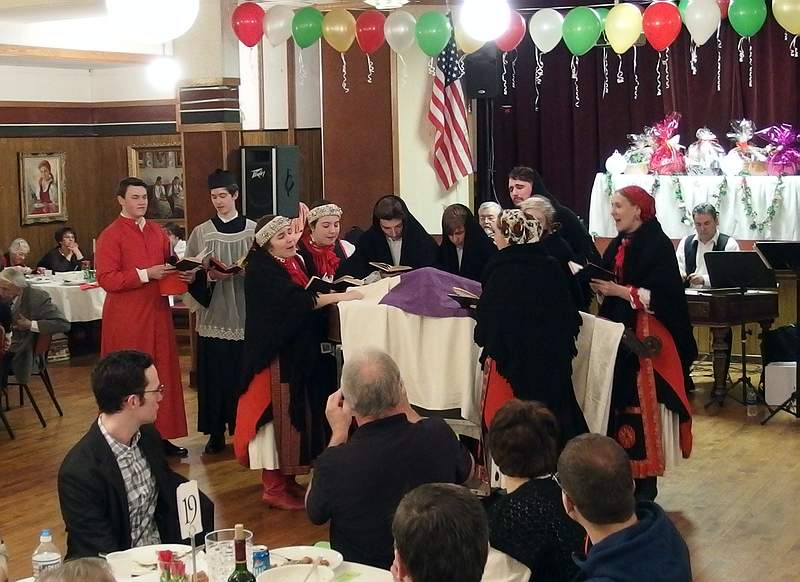
Hungarian Scout Regös Group had the funeral of the big old musician in the social hall of  Cleveland's St. Emeric to-day. He could not make it through carnival season. His absence during the upcoming Lent will be noticed. The young women wailed, and a man threw himself to the ground.
We are in the last few hours before the major penitential season of Lent, which many people see as a solemn and sober time. This is part of the final moments where humour can be played out. A mock funeral was held for the 'deceased' instrument of merriment. In one book it was called 'Bogo Temtes'. This had been done for decades in the Buckeye neighborhood around St. Margaret of Hungary. At that time it had initially involved Gypsy musicians. Last year it was revived by the new pastor at St. Emeric, András Mezei.
 The asperges (sprinkling) was done with a large kitchen whisk.


Sunday, November 4, 2012

Parish Saved from Oblivion

 
 incoming procession to a congregation overflowing with anticipation
Father Sandor Siklodi, past and present pastor of St. Emeric Cleveland read the Gospel, and gave an history of the last twenty-eight months. At times it was a bad dream. He, as all people present, were publicly grateful to Fr. Begin and Saint Colman's for saying so many Hungarian language Masses in the interim. All realised how much this helped the community to survive and thrive. Siklodi said words too kind concerning Bishop Lennon.
 a view at the Ave Maria window, and the press in the balcony
Of the eleven churches restored to public worship of God, in the Cleveland Catholic diocese, this church, Saint Emeric has physically the smallest nave, and sanctuary. Still they held six hundred people. Folding chairs were placed, everywhere they could fit, and some people stood.
 
 After the distribution of Communion, Jesus finally re-entered the tabernacle after a long absence. The tallest member of the congregation pulled down the tabernacle lamp, and lit it. The lamp was out for twenty-eight months. 
Before the Mass dismissal, the parish's procurator/organist presented an historical reflection on what has happened in the history, of the parish, the Hungarian nation, and the Catholic Church. To get to this Mass, in this church to-day, took the near moving of heaven and earth.

The time, noon 4 November echoed history. In 1456 a Christian force, led by Hungarians defeated the Turks at Nándorfehérvár (Beograd/Belgrade). Three years before, Constantinople (the Second Rome) fell. János Hunyadi is considered the top general of his generation, he had fought the Turks for more than a decade. This was his last battle. He soon died of contagious disease. His fame was so grand, that several nations claimed him. The next year, his son was elected king. The Hungarians believed the bells rang at noon by papal order after the victory.More recently, the short lived Hungarian independence revolt of 1956 was crushed on Sunday, 4 November.

But locally, this little parish became a cause célèbre for the world's Hungarians. The Hungarian government inveighed and cajoled diplomacy to the Vatican on the parish's behalf. The parish was opposed by a beyond remarkably recalcitrant bishop. They would not accept compromise, neither would he; but Rome did not relent. This the Mother of God, the parishioners, in various groupings (Templom Örzö, the street prayer vigils, the scouts), judicial and diplomatic actions, and justice all were on the same side. They found friends in Saint Colman's and other Catholics in town. The parish was "saved from oblivion". This was an historical moment in the church universal, and a great victory. It was the proper solution, to a falsely created problem.

Sunday, October 28, 2012

Last Prayer Vigil

 prayer vigils of Cleveland's exiled Catholics have ended
A chapter on the Catholic Church in Cleveland during the time of Lennonism is coming to an end. Saint Emeric is the last of the eleven resuscitated parishes to have an Homecoming Mass. That Mass will be noon, Sunday, 4 November 2012. That is next week. But to-day, there was the last parish meeting in the street, or so they thought. Their pastor Fr. Sandor Siklodi was waiting for some three dozen souls, and opened doors to get them out of the rain, and to congregate inside their church.

The Magyar language Mass had been at 9.45 am, before the lennonist forced (and police aided) eviction (1 July 2010), and it was the last eviction. Saint Emeric followed in the tradition begun by St. Casimir, after their lennonist eviction. They convened their parish outside their beloved, closed church building. They held constant, and you are aware of Cleveland weather, and met continuously. That time has come to an end.
 
Earlier to-day, at 9 a.m., many of the St. Emeric faithful joined in Mass at Saint Colman's. Saint Colman's, and its pastor, Rev. Fr. Robert Begin have supported the Emeric congregation. On the 1st and most 3rd Sunday afternoons an Magyar Mass was held at St. Colman's for the displaced Hungarians. Time, and again, St. Colman's has shown a keen and eager brotherhood for their fellow Catholics (and others), and less fear of their bishop. Father Begin mentioned at the beginning that the Emericians had suffered over these two years.
At the end of Mass a plaque of appreciation was presented to Fr. Begin, and the parish of St. Colman's by the people of St. Emeric's. An embroidered vestment was given to Fr. Begin, also.

This is history. It should be reported, and recorded, for the future reference of those interested in the elaboration and demonstration of the communal spiritual faith of the American people, and by those interested in the Catholic Church. Communities were told to disband, and some adamantly refused. They travelled from Caiaphas to Pilate, and Rome finally, and repetitively, agreed with them.

end of last exile service, for the now former exiles, who now possess their church again
WJW-TV8 was inside the church to record 
banner reads:   Isten Hozott vissza Sándor Atya
Welcome back Father Sandor

Wednesday, October 17, 2012

Guest Submission VII: St. Emeric's decree fulfilled

 supporters and press standing on public property during the stand-off 1 July 2010
 sit in ended
Today in the Plain Dealer, Michael O'Malley gives more of the events surrounding the announcement of this church which was the last to close in June of 2010.  The parishioners "univited" Lennon for the closing Mass, and told him we will not be here if you show up for the close — a boycott. Instead, they had a large prayer service with devotions the day before, and afterwards a number of parishioners led by John Juhasz stayed in the locked building so that the diocese could not get in the following day.  The doors were locked, and the chains were put on the interior of the doors.  The priest and the custodian knew nothing of the takeover plan.

The next day: diocesan workers found the doors locked, and they could not get in. They called the chancery, and then a stand off took place with all media in attendance.  St. Casimir supporters were on the outside witnessing the event. By mid afternoon the chancery called in the police, and told them that that the people in the church broke in and did all kinds of damage to the interior.  I was told this by the police commander, Keith Sulzer. The commander told me, that the diocese told him, if they do not come out immediately, to use a battering ram on the doors.  I told him that the chancery were liars, and that the people stayed in the church after the prayer service, and social, which ended around midnight.  They did no damage, and that they were praying inside.  The commander said, "I am a Catholic. I do not want to batter down the doors. Can I talk to someone".    Immediately we put him in touch with their attorney, Charles Feliciano, the former head consul for the diocese. Feliciano arrived.  A powwow was arranged inside, with the commander, attorney, and the faithful sit down occupiers. Then the commander brought, into the church a number of his men, whom he asked to sit in the pews and pray with the Hungarians.  So they did.

An agreement was reached with no arrests made, after the commander called the chancery, and had them agree to the terms of no arrests, and a meeting with the bishop.  The commander did his Christian duty, and a week later, Bishop Lennon met with the parishioners and counsel. No progress was achieved. The parish's pastor, Sandor Siklodi, had no idea of the sit in.  The next day, 
Lennon told him he cannot practice as a priest in Cleveland.  He told him to leave the diocese.

An appeal was made to Rome by the parish organist, Miklos Peller.  Saint Emeric followed the example of St. Casimir's and started a Sunday morning prayer vigil on the street, being the 5th closed parish to do the same. These parishioners, many of whom were in the 1956 Hungarian Revolution against the communists were not giving up without a fight.

After the 10 other churches were opened, Lennon kept punitively
stalling on St. Emeric. Rome had ordered them to be re-opened. Two more appeals were made to Rome concerning Lennon.  Lennon made a comment to the Pellers, that he is tired of this "ethnic stuff" and he will do what he wants to do, regardless of Rome. 

Rome had other ideas. The opening Mass will be on November 4th at noon.  St. Emeric's Day is November 5th.  How about this for a celebration? The parishioners have won out over tyranny by following the teachings of Jesus, living their Catholic faith, and staying together for the Sunday prayer vigil on the street in front of their beloved St. Emeric.


Joe of St. Casimir
— a friend of a voice from the rustbelt, and himself another voice

Tuesday, September 18, 2012

Közlemény

Real good news soon for Saint Emeric and the rest of the Catholics of Cleveland (and really the entire country) expected to be announced soon.
_______________
postscriptum 15 October 2012: Expect the delayed announcement from the Cleveland chancery/bishop this Thursday, 18 October. Part of the announcement will be noon Sunday 4 November.

Sunday, August 5, 2012

as the Homecomings become routine

A very few, perhaps a handful of people, frequently check this site for a story. I have a perspective on many things. Of course, not everyone is enthusiastic about my views. I did not intend this to be a religious page. But it has come to pass, in this portion of Rustbelt America [northeasterly Ohio], that, a continuing saga of parishioners and episcopal authoritarianism has been manifested unto an unfolding serial drama. It has been so for a few years now. That IS a religious story. Now, there is a religious press in this country. There are several religious presses, by denomination. This story has slightly caught the attention of the National Catholic Reporter; beyond that ... there is an approaching absence, at least a dearth. There are many so called 'bloggers' on religious themes. Many that self-identify as 'Catholic' largely fall into authoritarian, proscriptive, allies of a rigid episcopacy. They would have cheered Cauchon, the bishop that ordered Jeanne d' Arc to the flames of faggotted sticks. So, only the secular press is writing or filming this story, and they are limited by their understanding, and their critics and censors, whom are often allies of the episcopacy.

I do not always have a comment for this journal, and besides, i type slow. The camera helps, the pictures tell a story themselves; they often only need a little identification, and context. The last few weeks wonderful stories have been reported by the local press on the parish Homecomings. It is an interesting point, that no significant chancery presence has attended any of these. Are these Homecomings not good for the diocese? They are certainly good for the communities. All of these are Homecomings. Under church law, none of these parishes went out of existence. The doors were closed, and now they are opened. The very term 'Homecoming' is not a term appreciated by the chancery.

Pieces are coming together. People have returned. They are beginning to renew, or restart a routine. Saint Wendelin (Cleveland's very near West Side) has just completed their first week back. Their new pastor alluded to the first reading at Mass, where the nation under Moses first have manna. He pointed out their exile in the desert lasted forty years, and after the initial miracles [that allowed them to escape faro] they had to continue everyday existence. They had heavenly food to sustain them, so do we. We need to live with Jesus as a community.
Wendelin's Marian grotto
Mary's grotto has been repaired by parishioners this week. When the diocese took the statue, they knocked off several stones. With the statue returned, the masonry was to be restored. The parishioners did so.

Wendelin's exile is over. Not so, for its near neighbor, Saint Emeric. The only parish that is left in the street is St. Emeric's. Why is this so? Every Sunday they meet for a prayer circle at 9.45 a.m.. They are the only one of the five who held these regular gatherings still doing so. The need has disappeared for SS. Casimir, Patrick, James, and Wendelin. Fortunately, they still meet for Mass on one or two Sundays a month at Saint Colman. In that way, their community has held closer together. At any moment they are ready, and fully capable, of moving inside THEIR church. Their exile has continued too long [Rome called it to end on the First of March]. As Richard Lennon says, “I am the bishop, and I make the decisions”. It seems so. In an attempted dialogue, the parish representatives insist they require an Hungarian speaking priest. Some one needs to understand confessions and spiritual questions from those not comfortable, or proficient in English. Lennon, when someone speaks words that he disapproves of is not a pleasant interlocutor, “Don’t give me that ethnic stuff”. Some questions he will not answer, or is not capable of replying to.

Lennon defines the first step of the Homecomings is the selection of a pastor, whom will co-ordinate everything. Ten parishes have had pastors named, not one had been the old pastor. Saint Emeric's parish would be very happy with their old pastor returning. “No, this is to be the bishop’s decision. Father Sandor is off the table. I am the bishop, and I make the decisions”. The rough tone does not reproduce in the transcription.
Władek
Before Mass, a ninety-nine year old man prays before the high altar at St. Casimir. He had spent six years as a war prisoner of the hitlerite Germans. He was the fellow, that, unplugged Lennon's microphone during the Mass of Eviction. That began the women leading a protest that completely unnerved Lennon. Patriotic and Marian songs filled the church to the dismay of the lennonists. Władysław "Władek" Szylwian has outlasted occupation before; his abiding and enduring faith is a lesson for the learning.
This is just an interesting sign. On Broadview, in Parma, some churches have attempted to put a clever message to spur one to think of God, and their relationship with Him. I have posted a previous sign of St. Mary's Polish National. In the oldest writing there is no spaces between words, or punctuation. This can make thoughts less than straight forward. Was this message to read as two different sentences? or does it do so unintentionally? is the sentence three words, or four words long?

Sunday, July 29, 2012

notes on other parishes

parishioners begin to congregate
the prayer circle is complete, save for the cameraman who steps back to take a shot
It is a testament to resilience and faith that people come every week outside of their church and share their company with each other. This is a Christian community. It is important for people to recognise this witness, the constancy.

Cleveland had five parishes meeting regularly in their very near, but very real, exile. Now, only St. Emeric stands in exile. We know who put them there. Unfortunately, he has a special venom reserved for this people, and any ethnic suggestion. Lennon wants a cultural ethnic cleansing to be complete.

Someday, perhaps soon, they can freely meet inside. One day they will be having their last prayer circle. Never should anyone disregard, or disrespect this genuine Christian activity and constancy as a parish.

~~~oooooo~~~~~~~~~
~oooooo~~~~~~~oooooo~~~~~~~~~~~oooooo

Defenders of lennonism, and naysayers to the parishioners immediately crack with a comment on the huge turnout, the standing room crowds of the Homecoming Masses, that next week there will be a tiny turnout. First, it is a mean spirited remark. Second, it has been proven false. To defend Lennon, one must sin against the truth. Casimir had significantly more than an thousand the first week. The second week they had a few hundred, the third week they improved on that number. James had 1500 Wednesday, and 800 Sunday. These are higher figures than that of St. John Cathedral.

~~~oooooo~~~~~~~~~~oooooo~~~~~~~oooooo~~~~~~~~~~~oooooo

St. James had their Homecoming mid-week on their patronal feast (25 July). St. James is the most monetary valuable building in the entire diocese of Cleveland. There has been persistent rumours, that it was on the market to be sold to Moslems. The Church of James the Moor Slayer, filled with painted murals would have retained its stone work, and geometry. The murals could have been destroyed or covered over. Lakewood would have its own Hagia Sofia, or perhaps not, Lakewood passed an architectural landmark ordinance.

Their new priest was applauded as he climbed a held ladder and lit the tabernacle's lamp. People noticed that the vigilers were not a part of his circle, nor was much or any input from the Jacobites (St. James' parishioners) asked for, or accepted. Fr. Workman made sure to praise Richard Lennon in his remarks during Mass. A parish is the community of believers in it, it is not a priest and his bishop (or vice versa). The
Jacobites are in for a bumpy ride.

~~~oooooo~~~~~~~~~~oooooo~~~~~~~oooooo~~~~~~~~~~~oooooo

Some of the open churches have noticed their more portable items are missing. Lennon's business partner and sales agent, Henninger's, supposedly, extensively catalogued items. Vestments, altar linens, Eucharistic vessels, candlesticks are missing. Some people, and pastors are very timid, reluctant, or disinterested in following through for information, and property. In some cases inferior items were substituted. How much time was there from removal from the premises until the open, return, restore order by Rome?

~~~oooooo~~~~~~~~~~oooooo~~~~~~~oooooo~~~~~~~~~~~oooooo

Well, there have been other services conducted outside the spotlight, in almost sub rosa atmosphere. Some people are akin to fearful mice. Lennon would not like it, but the Church allows popular, spontaneous worship and activity.

~~~oooooo~~~~~~~~~~oooooo~~~~~~~oooooo~~~~~~~~~~~oooooo

A parishioner of Holy Trinity Lorain finally received notice from the Congregation for the Clergy, that the parish's appeal did not come in time. They suffered a purposeful delay in gathering information thought to have been necessary to submit.
________________
revised: noon 31 July

Thursday, June 30, 2011

the 59th Parish closed

On Cleveland's West 22nd street, people came to mark the exact year anniversary (30 June) of the closing of the 58th parish in the five years of the episcopal reign of Richard Lennon. Each parish's name was read out, and an old fire alarm bell was tolled for each. They prayed several prayers, including a prayer for the Divine Mercy. They sang several songs, including Faith of Our Fathers.

They told of the news elsewhere too. Mater Dolorosa parish in Holyoke, Massachusetts just started a sit-in vigil in their parish. Yesterday, a church was dedicated in Westerville, Ohio that bought a statue from the still appealing St. Peter, Cleveland.

They spoke of the hurt they felt, and the deceptions that occurred because of Lennonism. They had warm anecdotes of their parishes. A story of a man in his 90s pulling the plug on Lennon at St. Casimir's was applauded. They spoke of the mismanagement, and misrule in the American Church.Fr. Sandor Siklodi came back from Chicago to talk to his parish and friends. People spoke on the steps of the Hungarian parish of St. Emeric (Imre).
A crowd of 250 maintained for approaching three hours. Some left early, some came late, so that some more than that came in total.
Michael Polensek, the councilman from Collinwood, spoke of the importance to the neighborhood each church is. When a church goes away, the city around it decays.
Many speakers, from several parishes, and the officers of Endangered Catholics spoke. Some spoke very well, some spoke too long. Each held passion for their closed parish, and the fate of others.
The crowd was very attentive throughout, and occasionally responded enthusiastically.
Dr. Kenneth Chalker, Senior Pastor, University Circle United Methodist Church, perhaps stole the show. He spoke of the 59th parish that closed — the spirit and feeling of ecumenism. He spoke of the welcome and fellowship, he felt for the previous ordinary, Anthony Pilla. The new bishop, Richard Lennon, who except for one early appearance, when advised that it was a good political move, had no interest in ecumenism, or anything that approached it.
Some cameramen came, including one, believed to be, from the diocese. He left early. There was no police presence at all. It was a very peaceful demonstration.

Tuesday, March 22, 2011

Collection Baskets

The last parish closed in Cleveland was Saint Emeric. It was closed on the last day of the 2010 fiscal year.

In conversation and correspondence, Richard Lennon states that the diocese has a priest shortage, and a financial shortage. The parish closings were motivated by those perceptions.

From the chart provided by the diocese (and placed in remaining church bulletins this weekend past, 19-20 March 2011), one sees that the basket kitty rose in most fiscal years* from 2001 to 2008. With the implementation of the 'Reconfiguration', the basket declined in 2009, and then again in 2010.

The interpretation given attempts to present the figures in a 'positive' light. Inflation continues, though many people have less, the aggregate does not. Encouragement (or pressure) to give has not abated, to the contrary, it has increased. Perhaps, the vox populi (voice of the people) has begun to speak a language discernible to the bishop.
_________________________
*fiscal 2003 was also a decrease, which coincided with the revelations of the national clerical sex scandal, which first broke in Boston

Sunday, November 7, 2010

A year in the streets

There was a letter floating around announcing one of today's events:
St. Casimir lives!

The Polish national anthem begins with the line, Poland has not perished. In the original poem, the verb was 'died'. There is a stubborn determination for survival. It is not only for the nation, the land, but also of the faith and parish. St. Casimir Parish lives!

On 8 November 1917 Lenin took Russia. On 8 November 2009 Lennon took Casimir's. The party of Lenin lasted till 1991. We look forward for the end of our lennonist reign. We have been victims of unsympathetic tyranny, but we have not surrendered. We have fought the good fight, we have kept the faith.

The church buildings were taken, and St. Casimir's was thrown to the curb and street. We did not disband. We still congregate and celebrate our faith and community.

11.30 a.m. 7 November 2010 will be the 52nd Sunday gathering of St. Casimir-in-Exile meeting on the street and curb outside our church. It is true that not 100% of the members have joined us there, but friends that have recognised our plight, and the justness of our cause -- have. We will be joined by some of our brothers and sisters that have been dispatched from their parishes also, for we recognise our sadness is not a singularity, but others have suffered too.

We ask for the Divine Mercy of Jesus to come to us all. We believe in the words of Jesus, that were quoted by His apostle, Matthew:

For where there are two or three gathered together in my name, there am I in the midst of them.
There is another letter making the rounds, also:
"Nie Bojcie Sie", in Polish it means "Do Not be Afraid". These words are the famous words spoken by the late Pope, John Paul II on his first visit to Poland as the Vicar of Christ. These words ignited a nation to throw off the chains of tyranny.

These words are also the words that have inspired the faithful of St. Casimir Church to continuously hold prayer vigils outside the locked gates of their church, which was closed by Bishop Richard Lennon on November 8, 2009.

On this upcoming Sunday, November 7th, at 11:30 AM, the 52nd prayer vigil will be held to mark a year of these Catholics refusing to give up their parish.

Every Sunday, the prayer leader, Wojtek Fleszar repeats these words, "Today we pray and sing on the street in front of our boarded up church but we hope for the day that once again we can kneel in prayer inside our church".

No matter the weather, rain, snow or freezing cold, the Casimir Catholics and Catholics from throughout the diocese return to the vigils week after week.

Krysia Moreno, a longtime parishioner said that at the vigils, "I have witnessed faith in action, strangers coming together to pray." Another longtime parishioner, Ray Kasperski said that "Many people from other closed ethnic parishes attend the vigils to express their support and solidarity with us. God bless freedom of speech."

At St Casimir, this Sunday, the prayer vigil will be special. Representatives of churches that have been closed and churches that are appealing the bishop's closures to Rome will be attending.
A third note circulating, in part:
Sunday the 7th of November, the displaced Christians of the Diocese of Cleveland shall again meet in the streets, our sidewalk catacombs. We are not hiding in fear to worship God with our brethren. We are cast off by the bishop. We are visible to all, whom wish to see us. Richard Lennon is the canonical ordinary of the diocese. He is the latin rite bishop. He is rightfully bishop, but his actions are not pastoral, not loving, not Gospel inspired, nor are they in the spirit of canon law, and the tradition of Holy Mother Church.

We are five parishes that still exist and are functioning in brotherhood: St. Casimir, St. Patrick (West Park), St. Emeric, St. James (Lakewood) and St. Wendelin. St. Peter's is celebrating a valid and licit Liturgy (Mass) indoors in rented space, and is the sixth parish continuing against Bishop Richard's wishes.

We pray to Jesus, as our patron in His Divine Mercy, in which we trust to aid us. We ask the Holy Spirit to soften the hardened heart of our current overseer, Bishop Lennon.

We want our closed parish buildings opened, and our parishes recognised as existing, if not by Richard our bishop, then by his successor, whomever he may be. We built (or I should say, our forbears built these churches; we merely sustain them) these churches and parishes. We were here before the arrival of Richard Lennon, and we will be here after his departure. Our Catholic Christianity has been dealt a harsh blow by his tenure, it has not been vanquished. We were baptised Catholic, we live as Catholics, and we remain Catholic.

St. Emeric will celebrate their patronal feast (transferred from 4 November) of St. Emeric. Their exiled pastor, now ministering in Chicago, Sandor Siklodi will be celebrating with them on their cul-de-sac next to the West Side Market at 9.45. St. Patrick will have their service on the front steps of their church at 11.30. St. James will have theirs at 12.30. St. Wendelin will have one at 9.00. St. Casimir will meet on E. 82nd and Sowinsi, in the street, curb and sidewalk for the 52nd consecutive Sunday.
At St. Emeric four dozen came to pray outside their church. Their pastor, Fr. Sandor Siklodi, came from Chicago to lead the prayer litany. People sang national magyar hymns, and a translation of How great Thou art. Later they would go to St. Colman's to celebrate an early afternoon Mass. They also marked their patron's day [4 November, St. Emeric]. They have maintained a consecutive vigil since their eviction. They congregated again. There was noise from a constantly circling, advertising aeroplane (there was a nearby football to be played later), and the electric trains. Just before 10 o'clock the Cleveland police circled the cul-de-sac and went on.
Their faith remains constant. Later on the east side, the Casimiri met for the 52nd time since their eviction. Three other parishes also met on the street to-day: St. Wendelin, St. Patrick, and St. James. St. Peter's had Mass inside rented space outside the reach of Lennon.
To Saint Casimir more than two hundred people came. There is an argument in american society, that, if it's not on television, then it didn't happen. Two television cameramen came. They like to have pre-interviews, and to set themselves up for the best angles. They get shots, and then leave; but the event continues.
Across the street from the church is the closed convent, and on its lawn is a Madonna and Child statue. After the initial prayers, a procession was made there to lay flowers. Several people, young and old put them down. People sang a polish Marian hymn, and then recrossed the street to continue there. They sang, far from there best, but still the hymns count as augmented prayers. A few people spoke, the local councilman, TJ Dow; leaders of two lay groups Nancy McGrath of Code Purple and St. Peter's, and Patricia Singleton of Endangered Catholics and St. Patrick (West Park); Dr. Michael Klymiuk whose dream of the Black Madonna [Matka Boska Częstochowska] began the street vigils. Dr. Klymiuk scolded the behavior of Bishop Lennon, and proclaimed that the people also had proper say in the diocese.

All along the fence, there were many national flags, signs, posters, and photographs of the past vigils. Afterwards people enjoyed a pastry and coffee table.
Far away across the ocean sea, the situation has not gone unnoticed. The word on the seventh hill of Rome is, "Lennon e' pazzo."

Saturday, October 9, 2010

Hungarians at Colman's, Tayek tells stupid lies

Fathers Robert Begin and Sandor Siklodi
Bob Tayek lies for Richard Lennon. That is his job. He does it boldly and badly. It is noticed in Cleveland and elsewhere. A reporter from Los Angeles, Ralph Vartabedian, interviewed him about the huge number of closing eastern european parishes in the latin rite diocese of Cleveland. Tayek justified their closings, in part, by alluding to supposed absence of worshippers, “you can throw a baseball and not hit anybody.” After this was printed nationally, but not locally, some protesters at the suppression of St. Lawrence came with base ball mitts. One parishioner saw Tayek through an open front door, and yelled, "Hey Bob, wanna play catch?" No response.

Michael O'Malley of the local paper wrote, "Tayek said there have been no Slovak language Masses at St. Wendelin's for 25 years, so the need to serve that ethnic group is no longer there." This is a false statement, though appearing to be partly true. When the parish was formed all the Masses were in latin, but the parish was created to serve slovaks; so therefore, a slovak (or any ethnic parish) parish does not need to have Masses in their ancient vernacular, in order to qualify as an ethnic parish. Statements were made that Lennon was willing to have a slovak ministry to the slovaks of the to be suppressed St. Wendelin's and Our Lady of Mercy, but these folks wanted a parish and not a 'ministry'.
Father Sandor Siklodi distributing the Eucharist at St. Colman's, 3 October 2010.
Now, it can be supposed that these points are debatable and not false. One, open, and outrageous lie Tayek told was, that, the diocese never begins selling a church before it is closed. Tayek was quoted: "No property is placed for sale until a church is officially closed." Both a paper, and a television station, reported days before the suppression of St. Stanislaus, Lorain, the news that the buildings and grounds were openly being advertised on the internet through a real estate company for a stated asking price. Clearly, Tayek was lying, and the press never called him on it. St. Casimir's, whose suppression is under appeal, also was advertised, and that is canonically not allowed.

In yesterday's paper, a ridiculously stupid lie that Tayek told was reported:
"It's hard to understand why they won't go to St. Elizabeth's," said diocese spokesman Robert Tayek. "They have never given us a straight answer as to why they won't go there."
In this sentence there is so much garbage that cements the aptness of Tayek's nicknames—"Bull**** Bob" and "Baghdad Bob". St. Emeric's parishioners have given many reasons for the justness of their continuation, and for the unsuitability of giving up their parish to join St. Elizabeth's. Conversely, Lennon has given no reason to suppress St. Emeric's. Yet, the lennonists continue to lie. The diocese had seven hungarian parishes when Lennon arrived. One is opened now. In Cuyahoga County there were three hungarian parishes. Lennon told them two will be closed. That was an ultimatum. The parishes did not want to collaborate in their demise. They all wanted to be open. That was their first answer to Lennon, Armstrong (officer of parish dismemberment) and Tayek.

What did Emeric's have? They had money in the bank. They had a well maintained campus. They had their own priest, that came not from Cleveland's diocese, but from Alba Iulia, Romania (Gyulafehérvár, Transylvania). Emeric's priest, Fr. Sandor Siklodi was made persona non grata in Cleveland by Lennon. Siklodi is now going to Chicago which is willing to have an additional bi-lingual priest. St. Emeric's had parish organisations and extra-parish cultural organisations.

Why did the Emerics not want to go to Elizabeth's? They disliked the neighborhood. They did not find it easy, or appealing to go there. They want to drive to the near west side and not cross town, if it is acceptable that suburban parishioners need not have to drive into town for Mass, then why is it not acceptable for west siders not to drive a half hour longer to the east side? They believe that the elderly priest there will soon retire. They believe, that, after his retirement the parish will be changed from an hungarian parish to a territorial one. They also hear an I-490 extension may further delete the neighborhood, or will take the land that St. Elizabeth sits on. Tayek in a few words tells several lies.

Father Robert Begin, humourosly and graciously began Sunday's Mass at St. Colman's with a welcoming of St. Emeric's parishioners to St. Colman's, their "parish-in-exile". About 150, well over 140 of them hungarian, were there to celebrate the Divine Liturgy. It must be said, they are very grateful and appreciative of Father Begin and the parish of Saint Colman's. They had, at one time, hoped to negotiate some accommodation with another near west side parish, which was more politically akin to their views. That fell, and they now enjoy the warmth of their welcoming Catholic brethren at St. Colman's.

Afterwards they had coffee, and a long meeting to discuss how to continue as a parish community. They discussed Rome's attitude and the progress of their appeal. They also still grieved their eviction from St. Emeric's grounds. It is an harsh open wound. This is what they can not comprehend. How can the religion that they bind themselves so tightly to, in the form of the local administration, treat them so discourteously, and with such a grave, uncharitable animus?

They have secured an afternoon Mass for the first Sunday (of the month) at Colman's, they are considering one for the third Sunday, and one for the second at Elizabeth's, and if they are denied the space in a diocesan church, they are mulling using an Hungarian Lutheran Church, in which, the hand of Lennon can not extend, and which has welcomed Catholics to have meetings there.

Some of Emeric's community were very protective of their priest, and were at one point, uncomfortable in publicly announcing the further participation of Fr. Siklodi in a Mass in the diocese. Fr. Begin had no qualms or fears in this being public. Yesterday's newspaper made this public. Fr. Siklodi is no longer unemployed, and it is doubtful that he can be blacklisted further, now. Lennon is not going to Chicago.

Young crucifer leads ending procession at a bi-lingual Mass at Saint Colman's.