Showing posts with label dragon. Show all posts

Sunday, July 7, 2024

2024 Miscellany #10—here & there

sunset from Lakewood Solstice Steps 3 July 2024
Parma on Independence Day, celebrate while you still can.
1956 chevy bel air art deco jet bird hood ornament
I do take fotos of other people's dogs. She is COCO, half golden, half basset.
part of the Asian Lights Cleveland Zoo during assembly
Looking out Lorain Harbor, late in the day, into sun's glare.
On Ontario in Cleveland, is this sign collection an anthropomorphic robot?
On a Godawful hot day, we were in Columbus, stopped into COSI. This is part of Ocean with Poseidon. People could aim water jets into the urns. It was cool here, running water was in the exhibit. It was dark, i used flash, a kid operating a water cannon jumped back in shock, his father chuckled.
Well, this was before Independence Day. Next year, it may just be July 4th. As wonderful as the commemoration is, it is a day many are uneasy, especially animals. Enjoy and protect.
Scotch pine, birches, some maples, sycamore all shag off their bark. In English we do say shag bark hickory.

Wednesday, December 15, 2021

travelling about the city...

 one can see interesting stuff

Karma sees something novel.
One needs to pull the dragon to enter this building on Clifton, Cleveland.
restaurant dragon on the west side Cleveland
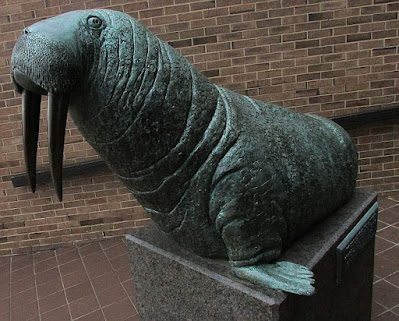
William McVey. Wally. 1980. outside Eastman Branch Cleveland Public Library
‘The time has come,’ the Walrus said,
‘To talk of many things:
Of shoes — and ships — and sealing-wax —
Of cabbages — and kings —
And why the sea is boiling hot —
And whether pigs have wings.
from “The Walrus and the Carpenter” by Lewis Carroll
on Holton, Cleveland
on Woodhill, Cleveland
St. Theodosius as seen from I-490 exit ramp.

Wednesday, April 7, 2021

Akron downtown walkabout


man walking dog
campaign for Devo into Rock Hall
tire dragon and Lock 3 flower mural
YMCA Building with tree blossoms by Lock 3

Akron Canal Park pitching mound and coyote?
Goose Street

Thursday, August 22, 2013

Zodiac heads

Ai Weiwei *1957, Dragon head 2010, 
one of twelve bronze animal heads of the Chinese zodiac on exhibition, Cleveland, O.
Cleveland Art Museum maintains a firm policy on NOT allowing photographs of contemporary works, and visiting works. These dozen bronze animal heads by the human rights activist and artist Ai Weiwei are not under that stricture. Beyond that, the museum requests people to send images of people standing next to them. Except for very tall people, one can stand directly beneath the heads. They are openly encouraging photographic interaction.

I thought, incorrectly, that one (or more heads) was (were) more popular than the others because of aesthetic reasons. I approached, the very friendly volunteer at the desk, and she said some people had come in with a favorite animal prior to seeing these, and most people wanted to take a picture with the totemic animal matching their birth.

These are mostly realistic in depiction, with veins in the ears visible in some. Most whiskers are absent, while their pores are distinct. Many of the animals have many beyond a full set of similar teeth, except for the snake which along with fangs has irregular razor like teeth. The snake looks like an extra-terrestrial movie lizardman.
she is reviewing her photography

Friday, August 16, 2013

Smok Wawelski

Smok is Polish for 'dragon', the one that once lived below Krakow's Wawel hill. Smok  is the most most famous Polish dragon. Now on the hill, there is a castle, and a cathedral. The cathedral is where the bishop and martyr Stanislaus Szczepanowski once was, and now his relics are there in a silver sarcophagus.

Smok was a fire breather, that enjoyed eating ruminant livestock (cows and sheep). Smok would also kill men who tried to kill Smok. The king promised his daughter to the man who would rid Krakow of the beast. She wished to be wed, but the dragon was not forthcoming. A shoemaker's apprentice had a slaughtered sheep stuffed with sulphur and sewed shut. Smok ate the bait, and exploded. The wedding took place.
Supra: we see Smok, a wall painted as Wawel Hill, and part of the two steeples of St. Stanislaus.
On East 65 in a Cleveland's Southeast (formerly) Polish neighborhood a topiary (and sculpture) of Smok is growing into place. This was a vacant lot, many buildings that were in the city are no longer. Here, a little park was formed. The dragon's head has been there a short while, and it took some time before that to have presentable shrubbery of some size, and form. Still a section before the end of the tail is absent, a tree is at the tip. The dragon's head had two long, thin, copper ears; it has one now.
his footprints

Monday, December 31, 2012

fourth foto miscellany 2012

 train passing by East 40and Payne
 Fruitland is not a store or park but an old elementary school on a street with the same name
 on East 79th near Sowinski
 sign in Cleveland City Hall
 Community Dragon on Payne Avenue and E. 39th
William Shakespeare at the Main Branch Cleveland Public Library

Friday, May 18, 2012

Dragons have come to Cleveland


five dragons on East 30th between Payne and Superior, Cleveland, O.

Ren Chen, Year of the Water Dragon, Guardian of the Eastern Sky with pearl

This is the seventh year of a public art project in, and near, Cleveland's Asia Town. In the Chinese zodiac it is the year of the dragon. There are twelve animals, and five cycles. This time, a water dragon. On one there is a limerick, reflecting Cleveland's geography and history: Eerie monsters lurked in our lake•This theory, we claim, a mistake•Crooked river caught fire• The lake's future loomed dire•These dragons guard all in their wake.

Last year there were rabbits, and this year their locales have dragons. It is a mostly one for one substitution. Some places have several years of animals on public sidewalk display. The dragon may be the most, culturally typical animal of the zodiac group, and maybe the most given to both traditional, and fanciful decoration. This sort of city distribution of a painted variety of the same model began with Zürich's lions in 1986, and then cows in 1998. The next year the herd crossed the ocean, and came to the capital of the Middle West, Chicago.

They were installed to-day, and over the weekend there is a street festival.

This one looks like a Japanese pen and ink calligraphy (sumi-e) piece.

Monday, May 2, 2011

George is moved

Window of St. George the Dragonslayer, in the closed and appealing church of St. Patrick, West Park Cleveland.

23 April is Saint George's Day, but not this year. 23 April was Holy Saturday. Saint George was transferred to to-day. Paschal Sunday [Easter] is the great movable feast. Its tide pushed George onward. It is normal for feasts to move when they fall in Holy Week.

It is also a reminder that time is relative. What is regular and accepted can change in relation. Resurrection Sunday governs the christian calendar, and many days are determined by it; some away, and some intermittently.

Saint George was born in Lydda, Palestine. He usually is understood to have been a soldier. His execution was 23 April 303. The year before the emperor, Diocletian, issued an edict purging the army of christians. George was celebrated as a saint very early, and the stories grew to the point of great unreliability to historic accuracy. The byzantines re-named Lydda, Georgioupolis.

The dragon tale came centuries later. It is an allegory, but many people accepted as true beyond that. The dragon is a symbol of dangerous and conquerable evil. George is the true and brave christian, and all the rest is accoutrement to the story.

Lydda was also a town that suffered more recently. In the middle of July 1948, many thousands of residents and refugees were driven out and marched toward Ramallah. In the 100°F heat hundreds perished. The government leader who ordered the Death March was David Ben-Gurion.

Monday, February 28, 2011

Sadao Watanabe

Sadao Watanabe *1913, 1996† was a Christian artist in Tokyo. The official religion of Japan is Shinto, but the ethos is Buddhist. Christianity is a small minority of one percent.

In the 20th century the Japanese were enthusiastic about technological acceleration of society. This was true under liberal democracy, and in militaristic fascism.

Watanabe began as a fabric dyer of kimonos. He was apprenticed into folk art tradition of mingei. This was anachronistic to the society. It was also, politically, suspect. Folk art was a socialistic movement, that was not favored among fascists or modernists.

The medium he chose was stenciling kneaded mulberry paper (momigami ). The paint was minerals in soybean whey, and the colors of Okinawan bingata fabric. This applied over a rice starch, the outlines in chinese black ink. The colors are bright and solid, the materials natural. The prints are similar in look to wood block prints, and for whatever reason, remind me of northwest Pacific Coastal Indian art.

Now as a youth he contracted tuberculosis and underwent a religious commitment. His sincerity and humbleness were deep. His subject matter was mostly biblical. He did treat some post-biblical Christianity.

His first champion in the West was James Michener. The Vatican had his prints displayed, as did Lyndon Johnson's White House. I have not found out which prints, he did many.
He portrayed non-Japanese characters in Japanese forms. Saint George looks like a samurai, but the serpent is not very menacing. The oriental dragon is not a symbol of evil. In Japanese mythology the emperor was a descendant of dragons. The dragons were wingless, yet flew, or flowed on chi energy (a sort of vital force). The dragon was sentient and capable of choice, and could choose to go bad.
Saint Francis' habit is a kimono. He blesses many colored birds of the same size and shape. The birds are treated as apostles.
Watanabe did several Last Suppers. Jesus, the largest figure (because of his importance) is top center with nimbus. Judas the Betrayer's face is not seen by the viewer, his purse of lucre is. The meal is Nipponese. Saki bottles are on table. The fish is special. In March and April the tai (sea bream) is red. This is the food of happiness and celebration. This is the food for parties and weddings, and gift giving. The culture of this food has been extant for centuries in Japan, and known before recorded time.

Here the diners are seated on the floor in kimonos as in Japan. They are in different poses as they are often depicted in the West. There is emotional and cultural impact in this. He acculturates Christianity into Japan.
Then Abimelech departing from thence came to the town of Thebes, which he surrounded and besieged with his army. And there was in the midst of the city a high tower, to which both the men and the women were fled together, and all the princes of the city, and having shut and strongly barred the gate, they stood upon the battlements of the tower to defend themselves. And Abimelech coming near the tower, fought stoutly: and approaching to the gate, endeavoured to set fire to it: And behold a certain woman casting a piece of a millstone from above, dashed it against the head of Abimelech, and broke his skull. Judges ix. 53.

Watanabe also illustrates lesser known stories of the Faith. Now, there is the Japanese traditional idiom in his work. The subject matter is foreign, and that is western. Now what is the most distinctive western physical characteristic? Hmm? — big, long, ridiculous noses.

He is not interested in perspective. His works while very figurative, are not concerned with visual realism. It is of a pre-renaissance abstraction. The eyes are not in the center of the head, but near the top as anatomical exactitude is not important. People perceive the eyes to be higher than they are. If the Japanese were of carolingian Europe, this could very well be a national style, not more divergent than celtic or slavonic from gothic.

In the spirit of Vatican II, and historical missionary evangelisation, such art could be on the walls of a church. It is not flamboyant. It is craftsmanship of artisan guild style. It is true art with a message and a spirituality. It is not empty polemic instead of art. There is truth and beauty, though the form may be unfamiliar. Not all Christian art needs to be in imitation of one style. I wonder how well known is this man's work?

Monday, June 21, 2010

Green Dragons of the World Cup

The World Cup championship for football (soccer) is a world fair of sport. States across the globe are represented. There are the large states with the small. The traditional football powers and the rare qualifiers.

This year the games are for the first time being played in Africa. The novelty that everyone has remarked on is the elongated, plastic cornet — the vuvuzela. The high decibel droning of thousands of ill played B-flats is constant. Vuvuzela is now a new word in the international lexicon. The spelling may become negotiable. I heard 'booboozayla'.

Now, many teams are represented by their traditional colors. Argentina is always in light blue and white vertical stripes. Holland is in that wretched orange. Many teams wear their flag colors, but not all. The germans like white. The italians in the blue of the past monarchy.

Slovenija is the smallest state in this year's tournament. They have green with light green. Their flag's tri-colors are white, blue, and red. Why green? As the tournament starts, a national tree and symbol was in bloom — lipa, the linden. The leaves are green and the flowers are light green. The lipa, the linden, leaf almost made the new flag. It has been on stamps and used as logos on many government and non-governmental items.

The dragon is the heraldic symbol of the capital city Ljubljana. There is a dragon's bridge in the city. The dragon is always green. The city's football team Olimpija, is nicknamed, the dragons. The world cup team is also, unofficially the green dragons.

Group play
13 June Slovenija 1 Algeria 0
18 June Slovenija 2 USA 2
23 June Slovenija 0 England 1