.JPG)
.JPG)
.JPG)
.JPG)
This year they turned on to Clark, a main street. The path has been subject to changes.
.JPG)
Bier carrying the Corpse.
.JPG)
.JPG)
Women of the parish carrying the Sorrowful Mother.
.JPG)
.JPG)
The women of Jerusalem. Veronica holds the veil.
.JPG)
.JPG)
.JPG)
.JPG)
A new generation rides.


iron cage for a previous air conditioner
There has been an influx of money for infrastructure on the street and nearby. New surface has just been placed on the intersecting Clark, the road markings have not been finished. Several other street improvements have been made. On the third corner of the intersection, a remodel of the Carnegie Library has been completed. Still, the neighbourhood has a rough and sketchy side.
.JPG)
.JPG)
.JPG)
.JPG)
.JPG)
.JPG)


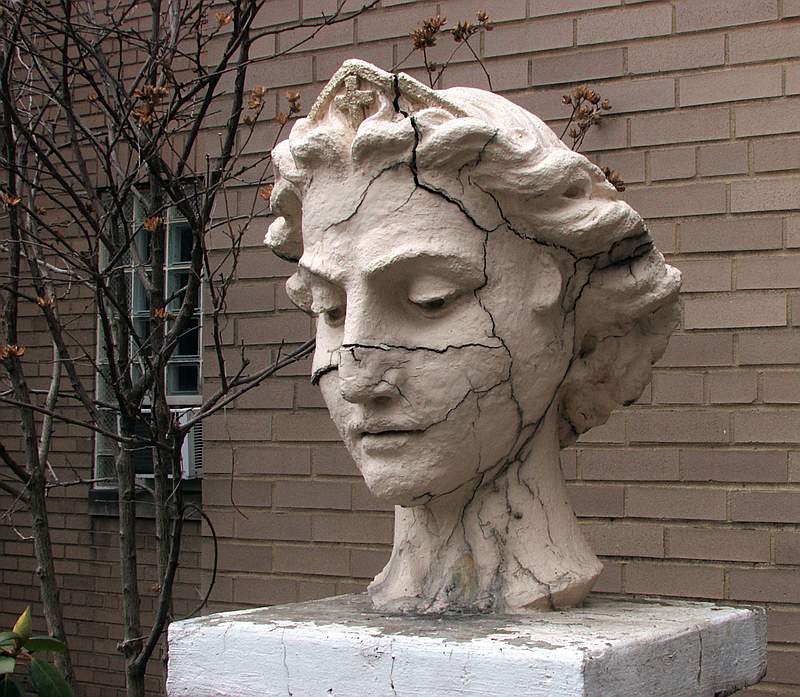
 Outside the main entrance to St. Michael's on Scranton in Cleveland, there are two remaining archangels, Gabriel (who has lost his horn), and Raphael (who has retained the fish). Between the landmark pair of uneven steeples, on the gable point of the roof there is an empty pedestal. For years there had been a third archangel, Michael, 22 feet tall. Over time the statue deteriorated, and a fear that it would crash below had it removed. The head was saved and placed in the rectory garden. Saint Michael's is a beautiful and active church and parish. In the sunlight, with the electric lights out, the inside church is peaceful and very comforting. There is color and volume. The space on the perimeter surfaces in all three dimensions is full of image, and the large volume between wall, floor and ceiling gives a balance; and within this space there is calm suited to be near the presence of Jesus.
 Huge earthquakes hit Peru. A slave, whose name is lost to history, transported from Angola had painted a mural of Christ during His crucifixion on a wall in the poorest neighborhood in 1651. That image is called Señor de los Milagros de Nazarenas. Jesus, under that title is the patron of the city. Outside that wall converts, often slaves prayed. In 1655 earthquake, the building fell, but not the portion of the painted wall. This devotion of the poorest Peruvians became troublesome to the bishop and the government. It was ordered to be painted over and destroyed, attempts failed. Eventually a church was built around it. On the 20th of October 1687 a catastrophic earthquake hit, causing a tsunami in Japan. Most of Lima was destroyed, but not that painted wall. The 28th of October 1746 Lima, Peru was shook by another earthquake. Thousand died as thousands died during the other quakes, the painting survived. People came to that wall and began a procession, and the trembling stopped. The next year, when an oil painting copy of was mounted on a litter of Señor de los Milagros, a second painting accompanied it. It was that of the Ecuadorian Virgen de la Nube, Our Lady of the Cloud.
 a retablo of Señor de los Milagros, Our Lord of Miracles
 Virgen de la Nube, Our Lady of the Cloud
 El Señor de los Milagros (with the Trinity; Mary, Mother of Sorrow; Mary Magdalen)
 What is physically distinct from a great distance and many spots are the two dissimilar spires. A while back, July 2009 (after the letter) the larger spire's cross was taken down, at the insistence of a restoration contractor. The verdigris copper cross had been there for more than a century. It's wooden base suffered some rot. It has a few bullet holes. It now stands, near the center of the nave wall, near the main entrance. A replica cross is planned to replace it, when funds allow. A continuing restoration is in progress, inside and out.
  exit hole
  In one of the holy water founts in the narthex someone dropped a cigarette butt. It was dissolving. The doors were wide open. A beautiful church, with a welcoming congregation is open to even disturbed, and disrespectful people. There were several incidents in the past. The building has been spray painted. The neighborhood is not so comfortably hospitable. I remember, indistinctly, the sexual assault of a religious sister by a man hired for occasional work.
 When Cleveland had people shopping in the department stores of downtown, Higbee's was the top of the line. Its twelve floors were part of the Terminal Tower complex. The central tower, sat over trains, and once was the tallest building between New York City and Chicago.
 Daughters of St. Paul had a bookstore at Ontario Street, kitty corner from Higbee's, now there are lawyers' offices there, and the property has been sold in speculation to a parking lot magnate. The sisters left behind a statue of Paul [it must not have been on Lennon's inventory].
 Hæc cum dixísset, convérsa est retrórsum, et vidit Jesum stantem : et non sciébat quia Jesus est. Dicit ei Jesus : Múlier, quid ploras ? quem quæris ? Illa exístimans quia hortulánus esset, dicit ei : Dómine, si tu sustulísti eum, dícito mihi ubi posuísti eum, et ego eum tollam. Dicit ei Jesus : María. Convérsa illa, dicit ei : Rabbóni (quod dícitur Magíster).
 St. Michael the Archangel, Cleveland, Ohio, has some fine windows from the old country. The old country being catholic south Germany. Mary Magdalen the Myrrh Bearer went to the sepulchre to anoint Jesus, for he died on the Parasceve and was quickly put into the tomb. Before the window illustration, a great deal of drama in the garden had happened again.