Showing posts with label St. Mary's Collinwood. Show all posts

Monday, September 11, 2017

2017 Miscellany #8 — church

 Light through stained glass, at St. Mary's Collinwood.
This was taken June 24th during the vigil mass, so during the 5 p.m. hour, and there is a tree outside the glass. The amount and quality of light changes through the year, and the day, and the visual effect on the same window will differ. Of course, the window is inanimate, but it is 'alive' with light. Glass is not all equal, the composition, and quality of craftsmanship either adds, or detracts from beauty.
 St. Vincent de Paul Akron
The oldest parish in Akron is St. Vincent, it is older than the diocese it is in. The building is from the beginning of the second half of the 19th century, these windows came later. In so many churches, the window openings are planned for and built before internal structures. Organ lofts, the steps that lead to them, and the organ may cover a window. Sometimes, part of the window is visible from the ground floor, another part of the window from the loft, and sometimes not at all.
These two fotos are of the scaffolding about Holy Name Cleveland, taken on a gray day before the rain came. Scaffolding as architectural quality too.

Tuesday, April 18, 2017

2017 Miscellany #1

 Annunciation Greek Orthodox and the three tallest buildings in Cleveland
 2 fotos after Palm Sunday Slovene Mass St. Mary Collinwood

 Waterloo Road Cleveland Collinwood outside Slovene Workmen's Home
Holy Triduum St. Stanislaus Cleveland

Saturday, November 15, 2014

roses in the snow

 to-day St. Mary Cleveland


For those around here, the local television has had wall to wall SNOWMAGEDDON. We lost the huskies some time ago, what can one do? Wednesday night we heard Minnesota, Wisconsin, and Upper Michigan were lost. We had two days of ribands miles across dump snow created from the lake. Yet, life goes on.

Sunday, October 21, 2012

Celebration of 'ethnic stuff'

 Celebration of 'ethnic stuff' as the shakedown continues.
  
Parishioners in Slovene village dress with clergy
St. Mary Collinwood
sign reads: Bog Živi vas in Marija Vnebovzeta
God lives in you and Mary of the Assumption
  Fr. John Kumše holding scarlet carnations and ribbons of national colors
also seated Fr. Zvonko Blasko (St. Paul Croat), retired Bp. Edward Pevec, Fr. Franci Petrič (Ljubljana, editor Družina)

The parish of St. Mary's of the Assumption in Collinwood, in Cleveland Ohio had a double celebration for their pastor. Father John Kumše recently turned sixty, in addition he has been pastor for twenty-five years. When he started at St. Mary's, he was the youngest pastor in the diocese. At the end of Mass, he held up a photograph of himself as a three year old, and said that was still him. He also said, that he has been here for twenty-five years, and wants twenty five more.

A beautiful bi-lingual Mass was accompanied by chorus, organ, and violinist. Hymns from Slovenia, music from Mozart, Rimskij-Korsakov and a colorful procession replaced the usual 10am and noon Masses. Afterwards a dinner was held in the parish hall, but before making that trip, there were trays of small plastic glasses with different sorts of 'potent potables'.

Yes, a celebration of parish community life of congregation and pastor occurred; the 'ethnic stuff' that their Bishop Richard Lennon so dislikes, that he does not even allow for it to be mentioned in his presence. An inserted page in the day's parish bulletin, it was highlighted that the bishop's "Rooted in Faith" shakedown was successful. The parish had to cough up $435,000 to prove it was vibrant; with 15% of the parish, already, responding for $473,000. Now, the bishop will allow them to keep 70% of the overage. Also noted, the parish expects a new sound system to cost $32,000. The bishop's financial office will rule on this. Lennon does not like celebrations, he likes collections. His tax on the weekly basket is 16½%, that is more than what Mitt Romney pays in federal tax.

One last note: one of the 'villagers' was from west of the Alps, his costume was with a kilt and sporran.

Saturday, August 13, 2011

St. Lawrence at St. Mary's

The vigil Mass, Saturday at St. Mary of the Assumption in Collinwood [Cleveland] also celebrated the patron saint of St. Lawrence Parish, which met for the Mass. The pastor of St. Mary's, Fr. John Kumse, after the homily on the Gospel told the story of the martyred deacon of Rome. At the end of Mass, he made a public appreciation of the Laurentian émigré diaspora coming to St. Mary's.

August 10th is Saint Lawrence's Day. That fell on a weekday, so the commemoration was done to-day, so as to get a bigger gathering. Saint Lawrence's choir sang in the loft, more in slovene than in english. Several sacramentals from St. Lawrence's parish had been redeemed by St. Mary's after Lennon had the diocese ransom the goods. There are several windows, statues and paintings from St. Lawrence's church in place at St. Mary's. Some of the members of St. Lawrence raised a collection to offset the bounty paid.

Beyond that, Lennon had received a final payment of $550,000 from the parish account of St. Lawrence after he evicted them. All in all, Lennon made a small fortune off of this suppressed parish, and there is still money to be made.
“Lawrence, the renowned Deacon of the Roman Church, confirmed his service of charity by martyrdom under Valerian (258), four days after the decapitation of Pope Sixtus II. According to a tradition widely diffused by the fourth century, he patiently sustained a terrible martyrdom on the grid-iron, having distributed the goods of the community to the poor whom he regarded as the true treasure of the Church.” — from the Roman missal

He[roman prefect] demands of the guileless guardian[Lawrence] of the sanctuary that the church wealth on which his greedy mind was set should be brought to him. But the holy deacon showed him where he had them stored, by pointing to the many troops of poor saints, in the feeding and clothing of whom he had a store of riches which he could not lose, and which were the more entirely safe that the money had been spent on so holy a cause. — from St. Leo the Great's sermon [85] on St. Lawrence

Thursday, August 4, 2011

What’s the difference?

Saint Lawrence has held four advertised Masses at the nearby Slovenian Home. St. Peter has held weekly Mass at the Baker Building. I have been asked twice by a reporter, “What’s the difference?”

Both parishes were suppressed by the ordinary, Richard Lennon. Lennon has peddled their property, even though Peter’s is still extant [according to Rome]. Both parish communities like their parish, and the company of their members; that is why they still meet.

Saint Lawrence’s community has known each other longer. Saint Lawrence’s parishioners are older: a higher average age, and a higher proportion of inter-generational membership, id est, they have pensioners whom grandparents were members. Saint Lawrence’s community is more homogenous in ethnicity [slovene]. They have not had a pastor for many years, their priest (that was the administrator) had been, and is, in a nursing home.

In the last year they held the church, at least six Benedictines said the only Sunday Mass. A missionary, who was a son of the parish, said Mass. A retired bishop, who had been a priest there, said Mass. The pastor of Immaculate Heart said Mass there. In short, the parish remained vital, ‘vibrant’ [a word Lennon has admitted he cannot define], financially prosperous, and no drain on the diocese.

Saint Peter’s has a younger community, with few inter-generational memberships, diverse in nationality and a resident pastor. Saint Peter’s is a more ‘progressive’ parish with even more resources.

Now, Saint Peter’s has continued just as before, but at a new address. Saint Lawrence has met as a congregation four times since eviction, but in a more social gathering. The Mass is a meal, but after Mass, Saint Lawrence has had a sit down meal, and sometimes music and dancing. A rump of Saint Lawrence has also met for Mass at the 10 a.m. slovene language Mass at St. Mary in Collinwood. It is quite evident they enjoy each other’s companionship.

What’s the difference? The Laurentians meet ad hoc, while the Petrines meet pro forma.

Monday, April 25, 2011

Easter in northeast Cleveland

St. Mary of the Assumption, Collinwood (Cle.), O.
We have a very late Easter this year. It was good that the Latin church shared the same day with the Orthodox. Often we have had snow on the day. This year Holy Saturday was in the 70s Fahrenheit. For the Paschal vigil, Easter fire is made outside the church to bring lighted candles into the church. The wind was sporadic, once started the fire blew flames. It shewed that polyester suits are impractical. People in the neighborhood, outside the church, continued to make extraneous noise taking no notice of the service.
Easter morning was drizzly and quiet. The Casimiri that gathered to pray in the street saw rain 'color' the statue of St. Michael in a second shade of grey. The parish [St. Casimir] is continuing, the week before they had a successful, fundraising dinner to send a parishioner, and his mother, to the old country for medical treatment. They also discussed the next week's May crowning, John Paul's beatification and the Polish Constitution Parade, that, they are marching in next Sunday on Fleet.

Thursday, November 11, 2010

The beekeeper and St. Martin

supra: painted bee panel at St. Mary (Collinwood), Cle., O.
To-day is St. Martin of Tours. Martin*316, †397, was raised to be a roman soldier. He became a christian, a pacifist christian, and then bishop of the gallican-roman town of Tours. He became a very popular saint.

Anton Janša *1734, †1773, was a successful peasant's son, who first became a painter, and then the austrian imperial beekeeper. Honey had been gathered from logs for centuries, logs became carpentered into hives. Janša stacked removable hives into houses, sort of an apartment building. These are still found in the slovene countryside.

About this time, apiarist farmers began to paint the front panels. People knew that bees were attracted to colors. The painted bee panels (panjske končnice) would help the bees find their homes. Janša being both a painter, and the bee guy; a brother became a professor of painting in Vienna, the capital. Vienna was the center of a polyglot, multi-national empire, it collected the talents of many lands.

The apiary panels are a slovene folk art. Its height was the two generations after the fall of Napoleon. At first the motifs were religious, they eventually became more diverse. The first one was a Marian one. Some stayed purely religious, others picked up folk tales, and some were secularly decorative. Now, these were painted by peasant men, and some of them had accepted the lore of the annoying, and shrewish woman. From Eve being tempted in the Garden, to women being allied to the Devil do show up in scenes, such as a devil sharpening a wife's tongue on a stone grinding wheel.

At the social hall of St. Mary's (Collinwood) there are nine. St. Florian and St. George are great favorites amongst the slovenes, and have a panel. The central panel of the nine is St. Martin.

Martin was first the great saint of traditional France. He suffered greatly under the protestant rebellion (his bodily remains were trashed). The revolutionary republicans destroyed his basilica. Centuries before the vikings destroyed the monastery, in which carolingian minuscule was developed. When world war one* ended on St. Martin's Day, the french saw his intervention.

The most famous story of Martin is that of sharing his cloak with a cold beggar. Later in the day the sun came out and melted the frost away. That what is called "indian summer" in the US, was called St. Martin's summer in the old countries.

At one time, the advent fast began the day after St. Martin's. St. Martin's was a great feast day, a precurssor to american Thanksgiving.

In the panel there is a barrel, and a bottle of wine. The first wine of the harvest was blessed, bottled and drank on St. Martin's. The geese are there for two reasons. Martin did not want to be bishop. He hid amidst geese, and the geese being geese--were noisy. He was found bishop. The big feast was with roast goose.
__________________
*
To-day there is but one combat veteran (Claude Stanley Choules*1901) alive of that war and he is living in Australia, and has no part in military celebrations.

Sunday, July 18, 2010

Parish souvenirs are to be ransomed

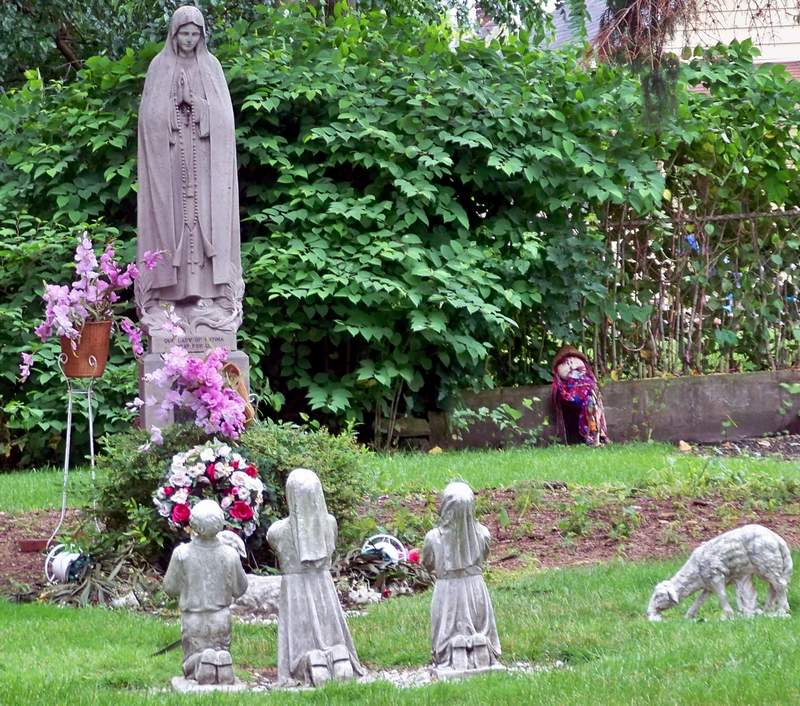
To some this looks like a shrine to Our Lady of Fátima with the shepherd children, Lúcia Santos and her cousins, Blessed Jacinta and Blessed Francisco Marto. The brother and sister died of the Spanish influenza pandemic, and Sister Lúcia became a carmelite and lived into her 98th year. To Richard Lennon, the bishop destroyer of Cleveland and creator of Lennongrad, it is $9,500. It was planned in consideration with Fortuna funeral home Many earlier conversations have been denied having occurred. Any statements are only good for the particular moment they are uttered.
To-day, the third Sunday of the month, the 10 a.m. Mass at St. Mary, Collinwood in Cleveland welcomes the parishioners of Saint Lawrence. Both are slovene parishes. The 10 a.m. Mass is in slovene. Some members will have to brush up on the mother tongue, really learn the mother tongue. The Saint Lawrence community is virtually all Cleveland born from the Broadway-Union neighborhood. Lawrence's Mass had been at 10 a.m.

They came together for the first time at Saint Mary's. After Mass they had pastry and coffee in the new parish hall. The one room where they conversed was decorated with items of pre-war, yet enduring, slovene culture. In the corner was a green ceramic stove, that some of the american born mistook as a bar. It was a pleasant place.

Some of Lawrence's parish wanted to maintain a slovene connection, hence St. Mary's (they could also have chosen St. Vitus). What was promised by the lennonist régime was that some items from St. Lawrence could go to St. Mary's. They can go if they are ransomed.
Lennon wants money for the Saint Lawrence statue too, amongst other items. please see earlier post first and last paragraphs.
____________________________________
Postscriptum 8 February 2011:
The Fatima group of statues are listed for $12, 000 on Lennon-Henninger. website.