Sunday, October 16, 2016

avocets

Friday, i saw a note on the birdy page that 14 avocets were at the Lorain impoundment. And yes, they were; my first viewing of an avocet. They are worth looking at. They are wading birds, and hunt insects and other tiny creatures in the mud. The avocets are related to the stilts, how they differ is their long, thinner beaks are curved upwards. The females more so. They swing their beaks like a a scythe through the water. When they are spotted in Ohio, they are migrants resting and feeding so as to be able to continue onward.
It is noted that colonies of avocets are very territorial, and will shoo other birds away. Above, a group of coots (mudhens) swim at peace. There were coots in the larger expanse of pond and reeds, occasionally calling. Coots do not 'sing', their sound is pleasant none-the-less.
The avocets stayed close together in a mini flock, but here above, a female mallard and a greater yellowlegs sandpiper mixed in. The avocets gave no notice.
Sometimes, i go to see birds, and a feeling of warm serenity washes over me. It did so with the avocets.

Thursday, October 13, 2016

rustbelt meets cornbelt

The title of this journal includes 'rustbelt', but the term has not been mentioned much in the essays. Dublin Ohio, two generations ago was surrounded by cornfields; then the outerbelt highway, I-270 came. Now there is further construction about and on that highway near Dublin, and inside of Dublin. What came to Dublin were golf course communities, and corporate headquarters of multi-storeys.
In the generation before Sam Frantz had a farm, where he hybridized corn. Now there are these hundred or so upright cement cobs, taller than a man. These monuments are similar to the crosses in a military graveyard; O, the opportunity for metaphor. Actually, it is better than described or pictured.

The installation is called, “Field of Corn (with Osage Orange trees)” by Malcolm Cochran, 1994. Dublin Arts Council has been graced with money, and a few of the local corporations donated. In front of trees there is a line of informative bronze plaques. There are two rows of osage orange trees, one existing before the project, and one planted with the project. During the Great Depression that came with the Hoover administration and twelve years of Republican national rule, and was dealt with by Franklin Roosevelt and the New Deal millions of osage oranges were planted in the Middle West as windbreaks, and were often used as property lines. In the Plain States these early Depression years were the dust bowl years, and 1936 was a drought year in Ohio also.
Continuing on one of the crossroads is Ballantrae park. Parking on what had been the end of a side street one sees through the driver's window, three giant hares (identifies as rabbits or bunnies) dancing on a hill top. With both the concrete corn and this park (which looks to be an extension of a golf course) the grass was well manicured. Limestone rocks were bunched together, and a very low fence of layers of rock with a top layer of perpendicular stones were part of the landscape of many properties in a great section of Dublin.

Sophie Ryder of Gloucestershire England has sculpted animals, and mythical creatures. Here she has sculpted mad March hares that people see as happy dancing bunnies. Before these came to Ohio, they were seen at The Hague, Netherlands in 2001. If one comes close to the towering metal lupines, one sees tools and other objects embedded. The limestone wall has leprechaun heads, some which squirt water in the summer. In front are ground spouts that also spray.

The first Dublin Art in Public Places project was Ralph Helmick's “Leatherlips” 1990. He sits looking over the Scioto River. This is the third in this essay of really interesting, if not great things to see and experience. There are several smaller pieces of public art about Dublin of diverse style and interest. But these three are large and fun. One thing about public art that is opposite of museum art is that public art can be touched. It is outside and is exposed to the elements, and becomes part of the landscape. A discarded porcelain toilet also fits that description, and some abstract public sculpture is of no greater quality. These three are quality and they add and blend to and with the other scenery in the landscape. The best is this first piece. The limestone slabs fit the slope of the hill. This Wyandot chief in his last years had in translation the name “Long Gray Hair”, and the long, lime walls of trailing, stacked stones fits that description. Next to the sculpture is a terraced theatre which continues the lines. Further fun is one can walk up behind and inside the statue and look out over the scalp.

Chief Leatherlips (as the white men called him) *1732,1810† had been executed by tomahawk nearby. His brother, and other Indians had imposed the sentence.  He was charged with sorcery, in an attempt to cover up politics. In 1794 the Indians lost the Battle of Fallen Timbers, the next year Leatherlips and others signed the Treaty of Greenville giving up most of Ohio. The loss of lands was increasing, and in years to follow, Tecumseh and his brother, the Shawnee Prophet, raised a confederacy of Indians. Leatherlips was not a party.

Wednesday, October 12, 2016

King Obama

I have posted several Sysack signs. She survived her brother in their family business. Every once in a while, a new sign goes up in front of her business. I had thought the anti-Hillary Clinton sign would hold until the election. It had several bugbears, and b.s., that Republicans love, and love to babble about.

Well, this one after several points of nonsense says the election will be voided, and Obama will declare himself king. The other figure portrayed is Jim Nabors as Gomer Pyle USMC. One of his repeated lines on the television was, "Surprise, surprise, surprise". Yes, this is the 'October surprise'.

Two things i like to point out: firstly, as a sign painter, she makes several spelling and other mistakes in sign after sign; secondly, as so many of these crazy 'conservatives' after their predictions (and points of argument) prove false, they never make the admission. Hillary Clinton will be elected president.

Sunday, October 9, 2016

Leif Erikson Day

This here bust is in one of the oddest places in Cleveland. When one spies the foto, one sees rail tracks, and an ivy covered jack knife bridge. It is near the mouth of the Cuyahoga River, on a saloon's parking lot; it is not free to park in the lot.

Leifr EirĂ­ksson was born in Iceland. Just before the year 1000 a.D. he converted to Christianity, preached in Greenland, and began settlements in North America.

First in Wisconsin, and then in Minnesota a day was instituted in his honor. There are many Norwegians in the upper Middle West. October 9th was chosen, because a ship arrived from Stavanger Norway in New York  on that date in 1825. Leif is a patron of Scandinavian immigration tom the new world.

Friday, October 7, 2016

Cleveland area Protestant Glass

I like stained glass, i like simple geometric color, but figurative glass has more to say. Most, not all, is found in churches. Some churches are only open for services, and if one goes to his regular community he has closed the window of opportunity to see some. 

I am more familiar with local Catholic glass. Wednesday night, a speaker suggested to see the glass at Lakewood United Methodist. In a room that was not the sanctuary, a multi lancet window had a large Nativity of Jesus window in the South German painterly style. I believe, that was the window he wanted to be seen. It was a warm friendly window, but at that time of day anyway, it did not receive enough sunlight. In several Protestant churches there is a huge multi-panel, multi-scene window. This church had two such in the sanctuary. In roughly would be a west transept spot there was a window with ten main panels with fifteen scenes plus tracery windows. The choir loft had another such window. The back of this window is seen outside from Detroit Avenue. One panel has Cleveland's Terminal Tower, formerly the second tallest building in the United States.
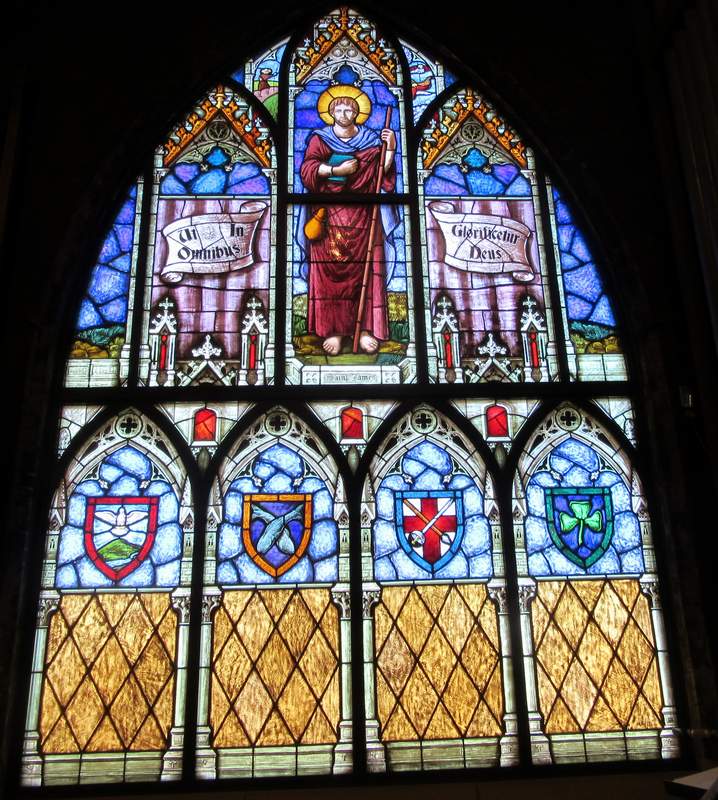
Cleveland's oldest church is St. John Episcopalian in Ohio City, supra is the church's patron above the altar. The church no longer holds public services.
St. James Anglican left the Episcopal diocese, and holds Anglo-Catholic high church services. It is on Cleveland's East 55th and Payne, and this window is above their organ and faces East 55th from the outside.
In East Cleveland on Euclid Avenue is the former St. Paul Episcopalian, it is now one campus of  the Empowerment Church. I saw a note somewhere from an old book mentioning how proud the original congregation (1896) was of their John La Farge window. La Farge taught Louis Tiffany how to use opalescent glass in stained glass windows. It had rained the day when i came with camera, and it was gray outside. On a better day, with more time, better pictures could have been taken. The bottom half of the window was of little interest, but noted who the three lancets were memorials to. Also, there is an interesting series of windows on the life of St. Paul, and another on Jesus. An attached hall/school also has good looking c. 1900? windows. Maintenance has long been neglected.

La Farge's father-in-law was Oliver Hazard Perry. John Jr. became a Jesuit priest. A large La Farge is on Cleveland's Public Square in the Old Stone (Presbyterian) Church.

Thursday, October 6, 2016

St. Andrew and the Democratic Presidency

Most of Parma Ohio is working class, and votes with the Democracy. This year there are more Trump signs (it seems), and Trump flags from flagpoles. With the vehemency trumpsters display, some democrats are not willing to show lawn enthusiasm. Inadvertently the vandals have made a Scottish flag of St. Andrew, which is a blue field with a white saltire/St. Andrew's cross. They may be familiar with the pattern since the traitorous confederate battle flag is a saltire too.

Tuesday, October 4, 2016

Revisiting 5th Christian Science

To-day the demolition continues. I photographed here [click] in January 2013.


Sunday, September 25, 2016

Protectors not protestors


Dakota Access Pipeline is, if completed, to bring hydro-fracked shale oil from Bakken oilfields in North Dakota to Illinois; a journey of over one thousand miles. ReZpect Our Water was formed in August 2016 by the Standing Rock Sioux of North Dakota to protect the source of water (Missouri River) for their reservation, and to protect their land. Already graves have been disturbed, and protestors attacked by private police (goons, and thugs) by pepper spray and dogs. This is a variation on the standard procedure that moneyed interests have always used in the United States. The United Nations knows of these actions:  American Indians are 'an aboriginal people' and as such are in similar positions as are other people of the third world. Many such people feel a stewardship to the land, and naturally through their culture act as guardians of  the natural world.

The Standing Rock Sioux Tribe are suing, are trying to use legal methods in appeal to the courts, and government. The moneyed interest, the oil company, Energy Transfer Partners is determined to have its way. A coalition of Indians, environmentalists, and justice advocates are not the people that are respected by economic royalists. They have been successful in having a corporate media silence.

As i type this, there is a commercial on the television spouting their public relation bullshit by a pretty actress calling herself "an energy voter". These invented people want unlimited drilling and mining of oil, gas, and coal. The term 'energy' is a euphemism dressed in  a science term. The same people who whore science for their screen to gather wealth, vigorously protest science to suggest climate change, and pollution.  And now they have an actor in a suit, who says the same thing in another commercial before they come back to ABC national news.
 Placing signs along MLK Jr. Blvd. at the American Indian Cultural Garden site


Well, we are all connected. Sunday the 11th, i was driving to Mass on Liberty/MLKJr., a line of autos behind me, Serbs parked and gathered to the right, and Indians gathered to the left. I saw a sign lettered with "Our sacred water", i knew of the pipeline out west and many Indians united in opposition.  I wanted to get out and foto, but did not have a comfortable spot to turn off, and thought it rude if i stopped took some pictures, and jumped back in the car.

This is a news story. When i saw it, i did see it as the proper place for such a demonstration. That street is a cultural thoroughfare, and the Indians are standing on their designated land. It fit. Also, on a side note, i am reminded of the old Irish rebel song 'The Rising of the Moon': "O then, tell me Sean O'Farrell, Where the gath'rin' is to be" In the old spot by the river, Right well known to you and me".

A friend of mine, we will call him 'John' because his name is John, teaches geology at a community college. He and me knew of another prayer vigil near this spot. Saint Casimir is east of Rockefeller Park's cultural gardens. We, and many others came to a pray outside the church for 139 weeks. We wanted Rome to rescind the local bishop's closure. And so it came to pass, the 140th week we were inside the church.

A prayer picnic has been organised by “Pumpkin” Marian Renee Concha-Saastamoinen and Ruben Borunda.  They plan to come every week, no matter what the weather, every Sunday at 11 a.m. at Native American Cultural Garden site, 781 Martin Luther King Blvd, in Cleveland, Ohio.

To-day, i joined them in a prayer circle. Now, i also had joined several times with the Hungarians as they held a prayer circle outside their closed church, St. Emeric. 'Emeric' is a version of 'America'. There was similarity. Singing comes naturally to these prayer vigils. The circle is a natural formation for people to enter, the form permits any number (certainly above two) to gather face to face, and it has neither beginning nor end. The circle promotes inclusion. People's bodies can naturally form symbols. Afterwards, everyone went to table for food and tamarack tea.

Hit the lights

 one of two stilt walkers
Years ago, neighborhoods and small towns had a picture show. In the 1920s many of these 'theatres' were built to be impressive. Many of these were built before talking pictures became the norm. Before World War I (then called the European War, here), films were just beginning to progress beyond the state of being a curiosity. The war was an all consuming effort in many countries. When peace came, the United States was not devastated, the war was not here—it was over there. 'Normalcy' became an expansion. The movies became a big industry, with an eager audience. The buildings to view them were built to be showplaces, where there was enough of an audience. After television, and changing demographics, these picture shows became less popular (profitable). They decayed, and many were destroyed.

Variety was the picture show on Lorain Avenue in Cleveland towards the edge of town. It was built in 1927. A tornado in 1953 came through the west side, and the vertical sign was destroyed. Now for some thirty years, the show was vacant. Yesterday afternoon and evening, a street party was held to see the restoration, and lighting of the marquee. One fellow sang as Frank Sinatra, and another as Dean Martin. It was a dog friendly crowd. Snacks were sold. People sang like Sinatra, 'Cleveland is my kinda town...'.
Government money and local activism came to make this project. Perhaps, in a couple of years pictures will be seen. The councilman for the ward has been Dona Brady, and she, Mayor Frank Jackson, and others spoke before the lights went on.
 First, the lower went on, and then the vertical.
The name of the movie house was 'Variety', and in the picture playing spot was 'This place matters'. Cleveland Restoration Society had used this slogan.

Tuesday, September 20, 2016

Château Hough


“...Burn down your cities and leave our farms, and your cities will spring up again as if by magic; but destroy our farms and the grass will grow in the streets of every city in the country.”—William Jennings Bryan 1896

Now, Bryan may have been this country's best orator. He was the Democratic candidate for the presidency three times. Many people loved Bryan. His popularity was a phenomenon in US history. There were many boys named after him. William Jennings Bryan Herman was an all star second baseman for the Cubs, and played later with other National League teams. He was also a team manager, and a member of the Baseball Hall of Fame.

Bryan still may be the most liberal candidate nominated by a major party. Unfortunately, he did not win a term. Especially, his first run in 1896 was thought to have been fixed against him. Some writers have ridiculed him through malice. Militarists, economic royalists, and social darwinists despised him. Some of Bryan's programme came to be under Franklin Delano Roosevelt.

Rural America was being crushed by bankers, railroads, and other financial interests that continued to gain power. Bryan was a populist, and a fervent Christian. He believed in social justice. The quote above affirmed the value of an agrarian society (not until 1920 census was the US an urban society), and its people, over an industrial society run by plutocrats. Well, Hough famously burned in riots in 1966. It has declined in population, and economically. The remaining population became poorer. Economic interests will not save them. Urban farming, horticulture, and raising and creating foodstuffs will make the urban land of value again. Small landholders may make a passable standard of living. So an hundred years on, Bryan's comment may be, “Your burned down cities, will be made into farms”.

Urban farming is starting to have a foundation in America. Mansfield Frazier had an idea, on Hough Avenue, Cleveland Ohio, there is a vineyard. Perhaps, it will be a pioneer in the city.
  Frontenac grapes were favored by birds. Netting was necessary.
  Traminette grapes
 The Frontenac berries were picked Saturday.
I first saw these vines in January 2011. The foot tracks, in the foreground, are on the sidewalk. There is no fencing. The house is gone, replaced by a bio-cellar building.